"You see, that's the whole point of being the government. If you don't like something you simply make up a new law that makes it illegal"
-Minister Dormandy in Pirate Radio
Just today the Supreme Court ruled in favor of a bunch of despicable people at the Westboro Baptist Church. For anyone living under a rock for the past few years, the people at Westboro do awesome things like protest at soldiers' funerals. Their logic is this:
1) God hates gays.
2) America is far too tolerant to gays.
3) God wants to punish America for being too tolerant of gays.
4) God kills soldiers as punishment for America's tolerance of gay people.
Yeah, they're juuuuuust a little goofy.
Back to the Supreme Court ruling. A family member of one of these soldiers sued Westboro and it eventually ended up at the Supreme Court who ruled 8-1 in favor of the protesters. It's my opinion that the only bad thing about this ruling is that it wasn't unanimous.
In America we like to talk about our "rights" "liberties" and "freedom". Those are all noble ideas and concepts that we all embrace... when it's easy. This is one of those cases where it's not easy. A family in mourning had to bury a man while a group of hateful assholes celebrated it. But their celebration occurred 1,000 feet away (far enough away that those at the funeral couldn't see them, and in compliance with city ordinance) and on public land. In my opinion those are all reasonable conditions to limit speech so that it doesn't interfere with the right of other people to be left alone.
But in a case like this it's far too easy to get caught up in the emotion and lunacy of the whole thing and look for ways to keep people from saying things that we disagree with. Any reasonable person would recognize Westboro's actions as something that is not desirable. But that should not give us the right to make it illegal or further limit it in some way. I fear that the opposite ruling of the Supreme Court, had it occurred, would not have elicited much outrage among American's who claim to embrace free speech. The reason is simple: because it's difficult to defend such horrible speech. Shouldn't the right to speak freely be defended the most when the speech is outside of our comfort zone since that's when it's most likely to be attacked?
If we only defend free speech (or any other "right" for that matter) when it's easy and when we agree with the speech, then we don't really defend speech at all. We simply defend speech that we agree with, or isn't offensive, or isn't controversial. Free speech should not have an asterisk next to it.
I think you can tell a lot about a man's character based on whether or not he is willing to, based on principle, defend something with which he fervently disagrees. I don't think American's would have rushed to the defense of Westboro Baptist if the Court ruled the other way, and hopefully I'm wrong about that. Thankfully they got this one right.
Wednesday, March 2, 2011


Thursday, February 17, 2011
Optimistic, Unrealistic Budget
President Obama recently released his budget proposal for next year and it is quite fantastic. It includes revenue increases of 65% and will reduce the deficit from 11% of GDP to 3.2% of GDP. It's wonderful! Fast track this through congress and start looking for retirement islands in the Caribbean! OK, maybe I'm being a little too sarcastic. Instead of caustic hyperbole and snarky rhetoric, I'll use some data and facts to let you know why this budget is a farce.
Here are the specifics of the recently released budget proposal (Source):
FY 2011 Projected Revenue: $2.174 Trillion
FY 2011 Projected Spending: $3.819 Trillion
FY 2011 Projected Deficit: $1.645 Trillion
Spending as % of GDP: 25.3%
Deficit as % of GDP: 10.9%
FY 2012 Projected Revenue: $2.627 Trillion
FY 2012 Projected Spending $3.729 Trillion
FY 2012 Projected Deficit: $1.101 Trillion
Spending as % of GDP: 23.6%
Deficit as % of GDP: 7.0%
FY 2013 Projected Revenue: $3.003 Trillion
FY 2013 Projected Spending: $3.771 Trillion
FY 2013 Projected Deficit: $768 Billion
Spending as % of GDP: 22.5%
Deficit as % of GDP: 4.6%
FY 2014 Projected Revenue: $3.333 Trillion
FY 2014 Projected Spending: $3.977 Trillion
FY 2014 Projected Deficit: $645 Billion
Spending as % of GDP: 22.4%
Deficit as % of GDP: 3.6%
FY 2015 Projected Revenue: $3.583 Trillion
FY 2015 Projected Spending: $4.190 Trillion
FY 2015 Projected Deficit: $607 Billion
Spending as % of GDP: 22.3%
Deficit as % of GDP: 3.2%
First, let's look at the 65% projected increase in revenue. Has this large of an increase in revenue ever occurred in such a short period of time? The answer is yes, but it comes with an asterisk or two.
Over the past 60 years there have only been three other years with a similar rate of revenue growth for a 4 year period (where each year is compared to the revenue period four years prior). They happened in 1979, 1980 and 1981. Those years also happen to have some of the highest rates of inflation in the 50 or so years of data. To be specific, 1979 had the 2nd highest inflation (11.3%), 1980 had the 1st highest (13.5%) and 1981 had the 4th highest (10.4%). Obama's budget doesn't assume those enormous inflation levels. In fact, it assumes 2% or less inflation, so it's not inflation that will be driving the enormous revenue growth.*
Another reason we could have a 65% increase in revenue would be because of a huge expansion of GDP. Again, in 1979, 1980 and 1981 we saw extremely high GDP growth of 11.7%, 8.8% and 12.1% respectively. Out of 65 years of data those are the 4th, 5th and 17th fastest years of economic expansion. Does the Obama budget expect similar GDP expansion that will be ranked in the top 10 years in recent memory? Not if you look at their published data. From the years 2011 - 2015 they expect the following GDP growth: 2.7%, 3.6%, 4.4%, 4.3% and 3.8%.

So we can't defend the rosy revenue projections based on huge GDP growth or high inflation.
What if we compare the projected increases historically on an inflation-adjusted basis. If we simply chart each year's federal revenue after correcting for CPI, and use the Obama budget CPI assumptions for the years 2011 - 2015 so everything is in 2010 dollars, we'll see that the budget proposal contains the 3 largest years of inflation adjusted revenue on record (2013, 2014, 2015).

So what do all these boring numbers mean? Simply put, the revenue assumptions that are in the budget proposal are extremely unlikely. The chances of them actually happening are close to 0% unless massive tax increases are part of the package, which the president insists will not happen. Of course, there's the chance that we see rapid growth, low unemployment, substantial increases in wages and low inflation all at once. Again, the chance of that happening is nearly 0%. The one things these numbers are good for is talking points and hopeful, optimistic speeches that garner votes by making us feel warm and fuzzy.** The one thing they are not is honest, and honesty is probably the most important thing we need from our leaders right now.
The truth is that if we don't act boldly right now, and neither party seems to be willing to do so, we will add at least another $5-7 Trillion to our $14 Trillion national debt by 2015. Unless politicians somehow address the "big four" - Defense, Medicare, Medicaid and Social Security - this budget proposal is little more than a fantasy. If you hear someone talk about our budget and they don't mention those four areas, it's simply partisan talking points used for positioning in the next election cycle. By lying to ourselves, we're only ensuring that our debt will grow, our GDP will remain largely flat, and we'll bring on a massive inflationary event that forces the federal reserve to choose between defending the dollar (raising interest rates) or defending the economy. It can't do both at the same time.
*As I've said before, the government lies about inflation. Anyone who has gone shopping in the last year knows that we have much higher inflation than what the official numbers show. We'll also have much higher inflation than what Obama and his administration is predicting. But that will also bring down his GDP expectations because GDP is inflation-adjusted.
**While our head is firmly planted in the sand.
Here are the specifics of the recently released budget proposal (Source):
FY 2011 Projected Revenue: $2.174 Trillion
FY 2011 Projected Spending: $3.819 Trillion
FY 2011 Projected Deficit: $1.645 Trillion
Spending as % of GDP: 25.3%
Deficit as % of GDP: 10.9%
FY 2012 Projected Revenue: $2.627 Trillion
FY 2012 Projected Spending $3.729 Trillion
FY 2012 Projected Deficit: $1.101 Trillion
Spending as % of GDP: 23.6%
Deficit as % of GDP: 7.0%
FY 2013 Projected Revenue: $3.003 Trillion
FY 2013 Projected Spending: $3.771 Trillion
FY 2013 Projected Deficit: $768 Billion
Spending as % of GDP: 22.5%
Deficit as % of GDP: 4.6%
FY 2014 Projected Revenue: $3.333 Trillion
FY 2014 Projected Spending: $3.977 Trillion
FY 2014 Projected Deficit: $645 Billion
Spending as % of GDP: 22.4%
Deficit as % of GDP: 3.6%
FY 2015 Projected Revenue: $3.583 Trillion
FY 2015 Projected Spending: $4.190 Trillion
FY 2015 Projected Deficit: $607 Billion
Spending as % of GDP: 22.3%
Deficit as % of GDP: 3.2%
First, let's look at the 65% projected increase in revenue. Has this large of an increase in revenue ever occurred in such a short period of time? The answer is yes, but it comes with an asterisk or two.
Over the past 60 years there have only been three other years with a similar rate of revenue growth for a 4 year period (where each year is compared to the revenue period four years prior). They happened in 1979, 1980 and 1981. Those years also happen to have some of the highest rates of inflation in the 50 or so years of data. To be specific, 1979 had the 2nd highest inflation (11.3%), 1980 had the 1st highest (13.5%) and 1981 had the 4th highest (10.4%). Obama's budget doesn't assume those enormous inflation levels. In fact, it assumes 2% or less inflation, so it's not inflation that will be driving the enormous revenue growth.*
Another reason we could have a 65% increase in revenue would be because of a huge expansion of GDP. Again, in 1979, 1980 and 1981 we saw extremely high GDP growth of 11.7%, 8.8% and 12.1% respectively. Out of 65 years of data those are the 4th, 5th and 17th fastest years of economic expansion. Does the Obama budget expect similar GDP expansion that will be ranked in the top 10 years in recent memory? Not if you look at their published data. From the years 2011 - 2015 they expect the following GDP growth: 2.7%, 3.6%, 4.4%, 4.3% and 3.8%.

So we can't defend the rosy revenue projections based on huge GDP growth or high inflation.
What if we compare the projected increases historically on an inflation-adjusted basis. If we simply chart each year's federal revenue after correcting for CPI, and use the Obama budget CPI assumptions for the years 2011 - 2015 so everything is in 2010 dollars, we'll see that the budget proposal contains the 3 largest years of inflation adjusted revenue on record (2013, 2014, 2015).

So what do all these boring numbers mean? Simply put, the revenue assumptions that are in the budget proposal are extremely unlikely. The chances of them actually happening are close to 0% unless massive tax increases are part of the package, which the president insists will not happen. Of course, there's the chance that we see rapid growth, low unemployment, substantial increases in wages and low inflation all at once. Again, the chance of that happening is nearly 0%. The one things these numbers are good for is talking points and hopeful, optimistic speeches that garner votes by making us feel warm and fuzzy.** The one thing they are not is honest, and honesty is probably the most important thing we need from our leaders right now.
The truth is that if we don't act boldly right now, and neither party seems to be willing to do so, we will add at least another $5-7 Trillion to our $14 Trillion national debt by 2015. Unless politicians somehow address the "big four" - Defense, Medicare, Medicaid and Social Security - this budget proposal is little more than a fantasy. If you hear someone talk about our budget and they don't mention those four areas, it's simply partisan talking points used for positioning in the next election cycle. By lying to ourselves, we're only ensuring that our debt will grow, our GDP will remain largely flat, and we'll bring on a massive inflationary event that forces the federal reserve to choose between defending the dollar (raising interest rates) or defending the economy. It can't do both at the same time.
*As I've said before, the government lies about inflation. Anyone who has gone shopping in the last year knows that we have much higher inflation than what the official numbers show. We'll also have much higher inflation than what Obama and his administration is predicting. But that will also bring down his GDP expectations because GDP is inflation-adjusted.
**While our head is firmly planted in the sand.
Wednesday, February 9, 2011
Regression To The Mean
"All truth passes through 3 stages. First, it is ridiculed. Second, it is violently opposed. And finally it is accepted as self-evident." -Arthur Schopenhauer
Warning: What you are about to read is very likely the insane ramblings of a mad man. God, I hope that's the case.
Imagine you receive a very large pop bottle that is full of rice at 12:00. At 12:01 you remove one of those grains of rice. At 12:02 you remove 2 grains. At 12:03 you remove 4 grains. You continue this, taking twice as many grains of rice out of the pop bottle every minute, for one hour. At 1:00 the bottle is empty. What's somewhat interesting is that at the 1:00 mark you end up taking over 500 quadrillion (576,460,752,303,423,500) grains of rice. But we've all learned about exponential growth like that. Here's what I find the most interesting about the thought experiment: at what point would you start to worry about your limited supply of rice?
If you're taking twice as many grains of rice every minute, and the bottle is empty in one hour, then at 12:59, one minute before you run out of rice, you still have 50% of your total supply of rice left. At 12:58, you still have 75% left. Clearly, it would be difficult to plan ahead and prepare for a depleted supply of rice when you still have a vast majority of your total supply 2 or 3 minutes before you run out. This becomes even more disturbing if you imagine a bottle of unknown size full of an unknown, but finite, amount of rice. And if you imagine that your entire existence is dependent on the unknown, finite amount of rice in the bottle, the problem becomes dreadfully catastrophic.
Now instead of a huge pop bottle and rice, think about Earth and oil.
Oh shit...
You can figure out the doubling rate of something with some very simple math. If you have a continual rate of growth, all you have to do is divide the rate of growth into 72 and you'll get the doubling rate. So if you had $100 and every year you earned 10% interest on that money, you would have $200 in a little over 7 years (72/10 = 7.2). Another 7.2 years later you would have $400. And so on.
We can look at this another way using some more simple math. Say you start to double the number of apples you eat every year. The first year you eat 1 apple. The next year you eat 2 apples. The year after that you eat 4 and so on. 1, 2, 4, 8, 16, 32, 64, 128. That's the number of apples you eat for 8 years. If you start to add these numbers up you'll notice that the number of apples you eat in any given year is one more than the number of apples you've eaten in all the previous years combined. 1+2+4+8+16+32+64 = 127, one less than the total eaten in the next year alone. This holds true no matter how large the numbers get. That's why at 12:59, before 576 quadrillion grains of rice are pulled from the bottle, the bottle is still half full.
A quick google search (that's as much effort as I was willing to expend) showed that from 1900-1973 the average growth rate of oil consumption was 7%. It doesn't seem like much until you figure out that it means you double consumption about every 10 years (72/7=10.3). That means that in the 1920's we used more oil than the two previous decades combined. In the 1960's we used more oil than the previous six decades combined. However, since then, the growth rate has actually declined for a variety of reasons, but if we assume a conservative average growth rate of 3% for world wide oil consumption, that means that we use twice as much oil per year every 24 years. Instead of taking 10 years to consume more energy than all the previous years combined, it would take 24 years. That also means that only 24 years before we run out of oil, we'll still have 50% of the world's total oil supply (a lot of oil, relatively speaking) in the ground.
Oh shit...
If you think of a bell curve and imagine that it represents global oil production, the top of the bell curve would represent what is called "Peak Oil". At that point, the world reaches its peak of oil extraction. That means that no matter how much money or effort you put into the oil industry, it will be impossible to equal the oil supply that was reached at that point. That also means that at Peak Oil, you only have 24 years worth of oil left (assuming a continual 3% growth rate, which would be virtually impossible*). And since we don't know how much oil is present in the planet, we won't know when we've reached Peak Oil until after the fact, when the supply fails to reach the level it was at when it peaked. In the rice and pop bottle example I mentioned earlier, Peak Oil is 12:59. And we won't know that we reached Peak Oil until a few seconds after 12:59.
Oh shit...
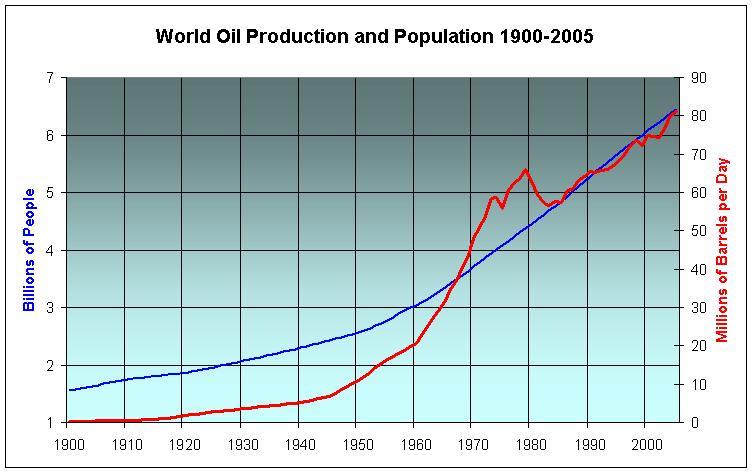
As of right now, the most oil that was extracted from the earth was 73.72 million barrels per day. That was in 2005. Since then, we have failed to reach that level of oil production. To put it in other terms, our oil production peaked somewhere around 2005.
Shit shit shit! Ohhhh shit!
Now that doesn't necessarily mean that we reached Peak Oil in 2005.
Phew!!
The declining supply was most likely a result of falling demand due to the worldwide recession we've been going through, among other things. That same data also shows that oil production peaked in 1979 and we didn't see that same level of production until 1996**, so there are obviously peaks, valleys and plateaus in the curve. That also demonstrates that we will be on the downward side of the slope for a long time before people are aware of it.
But some optimistic current estimates are that we will reach Peak Oil in 10 to 40 years. Of course, it's extremely difficult to estimate that with any accuracy because the governments in the Middle East that produce the world's oil supply, and the governments around the world who research these things, would never tell the world that their reservoirs are running dry. But there will certainly be signs to look for. Drilling for oil on land is by far the most efficient way to get oil. The total energy used to drill test wells and everything that goes into finding and extracting oil is very small for land drilling. Drilling in the ocean is much more inefficient. You have to expend a lot of energy just to find oil, and you need to find a lot more oil before you start to get more energy than you put in. So it's very disconcerting to hear that Saudi Arabia, a country that currently has at least 20% of the world's known oil reserves, is investing heavily into offshore oil exploration. There is only one reason why they would do that, and it's the same reason America started doing it after we reached Peak Oil in 1970: they're running out of places to drill on land. And then there's this recent story where Sadad al-Husseini, a geologist and former head of exploration at the Saudi oil monopoly Aramco, claims Saudi Arabia overstated its oil supply by 40%.
Maybe the drop in oil production since 2005 wasn't simply due to the global recession. After all, the recession didn't really start until late '07, early '08. Oh, and there's the little story that nobody really talked about where the International Energy Agency claimed that we saw Peak Oil in 2006.
Oh shit...
With the laws of supply and demand, it's safe to assume that a global oil shortage will cause prices to go up to a level where the average person cannot afford it. When that happens, things like electric cars as well as solar and wind power sources will finally become more cost effective, and more prevalent as a result. But make no mistake, the oil we use to drive our cars and light our homes is only slightly more significant than a drop in the bucket. It takes 7 gallons of oil to make one tire on your car, electric or not. It takes several gallons of oil to produce and transport the steel used to make the car. Nearly everything you buy only exists because of oil. Plastics, which are found in almost all consumer goods, packaging for food, etc only exist because of oil. Your toothpaste and toothbrush has oil in it. Of all the things you use throughout your day, nearly 100% of it only exists because humans have figured out how to use oil to make it and/or get it to you. Expecting electric cars and solar panels to solve the problem is extremely foolish and extraordinarily naive. Oh, and there's this little problem.
Probably the single most important reason we have our high standard of living is because a few farmers can effectively feed everyone in the country. The technological advancements in farming freed up the masses to pursue other interests, like building transistor radios, TVs, satellites, space shuttles and producing steel, cars, computers, cell phones, etc. If the majority of people had to spend the majority of their time growing food, none of that would have existed. Modern farming only exists because of oil. It powers the tractors that plow the field, fertilize the ground and plant the seeds. It powers the airplane that sprays petroleum based chemicals that increase yields. It powers the combines that harvest the crop. It powers the trucks that transport the crops to factories that use energy to make bread, sugar, flour, and so on. It powers even more trucks that bring the final product to your local grocery store. It powers the ships that import all the things we want to eat, but are grown on another continent. In one study, David Pimentel and Mario Giampietro concluded that the industrialized world uses 10 calories of petroleum based energy to produce 1 calorie of food energy.
All of this has lead to a population explosion that is difficult to comprehend. It took all of human history up until 1804 to reach 1 billion people. It took another 123 years to add another billion people. It then took 33 years to add another billion people. We're currently adding a billion people to the planet every 10-15 years***. It's no coincidence that this population explosion occurred at the same point that humans started to use oil to power their societies. Humans aren't as unique as we like to think we are. Whether it be bacteria in a petri dish, caribou on a predator-free island, or humans with a few trillion barrels of oil, any organism that is put into favorable conditions will experience a population explosion. Remove the favorable conditions and the explosion will be followed by a drastic decline. None of the human population growth of the last century or two would have existed were it not for one thing. In economics, they call that a bubble. And every bubble must pop at some point.
Oh shit...
Warning: What you are about to read is very likely the insane ramblings of a mad man. God, I hope that's the case.
Imagine you receive a very large pop bottle that is full of rice at 12:00. At 12:01 you remove one of those grains of rice. At 12:02 you remove 2 grains. At 12:03 you remove 4 grains. You continue this, taking twice as many grains of rice out of the pop bottle every minute, for one hour. At 1:00 the bottle is empty. What's somewhat interesting is that at the 1:00 mark you end up taking over 500 quadrillion (576,460,752,303,423,500) grains of rice. But we've all learned about exponential growth like that. Here's what I find the most interesting about the thought experiment: at what point would you start to worry about your limited supply of rice?
If you're taking twice as many grains of rice every minute, and the bottle is empty in one hour, then at 12:59, one minute before you run out of rice, you still have 50% of your total supply of rice left. At 12:58, you still have 75% left. Clearly, it would be difficult to plan ahead and prepare for a depleted supply of rice when you still have a vast majority of your total supply 2 or 3 minutes before you run out. This becomes even more disturbing if you imagine a bottle of unknown size full of an unknown, but finite, amount of rice. And if you imagine that your entire existence is dependent on the unknown, finite amount of rice in the bottle, the problem becomes dreadfully catastrophic.
Now instead of a huge pop bottle and rice, think about Earth and oil.
Oh shit...
PART 1: OIL AND GLOBAL POPULATION
You can figure out the doubling rate of something with some very simple math. If you have a continual rate of growth, all you have to do is divide the rate of growth into 72 and you'll get the doubling rate. So if you had $100 and every year you earned 10% interest on that money, you would have $200 in a little over 7 years (72/10 = 7.2). Another 7.2 years later you would have $400. And so on.
We can look at this another way using some more simple math. Say you start to double the number of apples you eat every year. The first year you eat 1 apple. The next year you eat 2 apples. The year after that you eat 4 and so on. 1, 2, 4, 8, 16, 32, 64, 128. That's the number of apples you eat for 8 years. If you start to add these numbers up you'll notice that the number of apples you eat in any given year is one more than the number of apples you've eaten in all the previous years combined. 1+2+4+8+16+32+64 = 127, one less than the total eaten in the next year alone. This holds true no matter how large the numbers get. That's why at 12:59, before 576 quadrillion grains of rice are pulled from the bottle, the bottle is still half full.
A quick google search (that's as much effort as I was willing to expend) showed that from 1900-1973 the average growth rate of oil consumption was 7%. It doesn't seem like much until you figure out that it means you double consumption about every 10 years (72/7=10.3). That means that in the 1920's we used more oil than the two previous decades combined. In the 1960's we used more oil than the previous six decades combined. However, since then, the growth rate has actually declined for a variety of reasons, but if we assume a conservative average growth rate of 3% for world wide oil consumption, that means that we use twice as much oil per year every 24 years. Instead of taking 10 years to consume more energy than all the previous years combined, it would take 24 years. That also means that only 24 years before we run out of oil, we'll still have 50% of the world's total oil supply (a lot of oil, relatively speaking) in the ground.
Oh shit...
If you think of a bell curve and imagine that it represents global oil production, the top of the bell curve would represent what is called "Peak Oil". At that point, the world reaches its peak of oil extraction. That means that no matter how much money or effort you put into the oil industry, it will be impossible to equal the oil supply that was reached at that point. That also means that at Peak Oil, you only have 24 years worth of oil left (assuming a continual 3% growth rate, which would be virtually impossible*). And since we don't know how much oil is present in the planet, we won't know when we've reached Peak Oil until after the fact, when the supply fails to reach the level it was at when it peaked. In the rice and pop bottle example I mentioned earlier, Peak Oil is 12:59. And we won't know that we reached Peak Oil until a few seconds after 12:59.
Oh shit...
As of right now, the most oil that was extracted from the earth was 73.72 million barrels per day. That was in 2005. Since then, we have failed to reach that level of oil production. To put it in other terms, our oil production peaked somewhere around 2005.
Shit shit shit! Ohhhh shit!
Now that doesn't necessarily mean that we reached Peak Oil in 2005.
Phew!!
The declining supply was most likely a result of falling demand due to the worldwide recession we've been going through, among other things. That same data also shows that oil production peaked in 1979 and we didn't see that same level of production until 1996**, so there are obviously peaks, valleys and plateaus in the curve. That also demonstrates that we will be on the downward side of the slope for a long time before people are aware of it.
But some optimistic current estimates are that we will reach Peak Oil in 10 to 40 years. Of course, it's extremely difficult to estimate that with any accuracy because the governments in the Middle East that produce the world's oil supply, and the governments around the world who research these things, would never tell the world that their reservoirs are running dry. But there will certainly be signs to look for. Drilling for oil on land is by far the most efficient way to get oil. The total energy used to drill test wells and everything that goes into finding and extracting oil is very small for land drilling. Drilling in the ocean is much more inefficient. You have to expend a lot of energy just to find oil, and you need to find a lot more oil before you start to get more energy than you put in. So it's very disconcerting to hear that Saudi Arabia, a country that currently has at least 20% of the world's known oil reserves, is investing heavily into offshore oil exploration. There is only one reason why they would do that, and it's the same reason America started doing it after we reached Peak Oil in 1970: they're running out of places to drill on land. And then there's this recent story where Sadad al-Husseini, a geologist and former head of exploration at the Saudi oil monopoly Aramco, claims Saudi Arabia overstated its oil supply by 40%.
Maybe the drop in oil production since 2005 wasn't simply due to the global recession. After all, the recession didn't really start until late '07, early '08. Oh, and there's the little story that nobody really talked about where the International Energy Agency claimed that we saw Peak Oil in 2006.
Oh shit...
With the laws of supply and demand, it's safe to assume that a global oil shortage will cause prices to go up to a level where the average person cannot afford it. When that happens, things like electric cars as well as solar and wind power sources will finally become more cost effective, and more prevalent as a result. But make no mistake, the oil we use to drive our cars and light our homes is only slightly more significant than a drop in the bucket. It takes 7 gallons of oil to make one tire on your car, electric or not. It takes several gallons of oil to produce and transport the steel used to make the car. Nearly everything you buy only exists because of oil. Plastics, which are found in almost all consumer goods, packaging for food, etc only exist because of oil. Your toothpaste and toothbrush has oil in it. Of all the things you use throughout your day, nearly 100% of it only exists because humans have figured out how to use oil to make it and/or get it to you. Expecting electric cars and solar panels to solve the problem is extremely foolish and extraordinarily naive. Oh, and there's this little problem.
Probably the single most important reason we have our high standard of living is because a few farmers can effectively feed everyone in the country. The technological advancements in farming freed up the masses to pursue other interests, like building transistor radios, TVs, satellites, space shuttles and producing steel, cars, computers, cell phones, etc. If the majority of people had to spend the majority of their time growing food, none of that would have existed. Modern farming only exists because of oil. It powers the tractors that plow the field, fertilize the ground and plant the seeds. It powers the airplane that sprays petroleum based chemicals that increase yields. It powers the combines that harvest the crop. It powers the trucks that transport the crops to factories that use energy to make bread, sugar, flour, and so on. It powers even more trucks that bring the final product to your local grocery store. It powers the ships that import all the things we want to eat, but are grown on another continent. In one study, David Pimentel and Mario Giampietro concluded that the industrialized world uses 10 calories of petroleum based energy to produce 1 calorie of food energy.
All of this has lead to a population explosion that is difficult to comprehend. It took all of human history up until 1804 to reach 1 billion people. It took another 123 years to add another billion people. It then took 33 years to add another billion people. We're currently adding a billion people to the planet every 10-15 years***. It's no coincidence that this population explosion occurred at the same point that humans started to use oil to power their societies. Humans aren't as unique as we like to think we are. Whether it be bacteria in a petri dish, caribou on a predator-free island, or humans with a few trillion barrels of oil, any organism that is put into favorable conditions will experience a population explosion. Remove the favorable conditions and the explosion will be followed by a drastic decline. None of the human population growth of the last century or two would have existed were it not for one thing. In economics, they call that a bubble. And every bubble must pop at some point.
Oh shit...
PART 2: UNLIMITED GROWTH AND REGRESSION TO THE MEAN
Every major economy on the planet is only sustainable and effective if continual growth exists. We all know this without even thinking about it. We put money in the bank, the banks use that money to invest in new business, growth occurs, wealth is created and banks get their money back with interest. The growth of the new business creates more people with more money who put it in the bank who can then make more loans to more businesses. That cycle works wonderfully as long as growth takes place. Without growth, that system could never exist. Depositors would lose out on their savings because it would not have grown with the bank's investment. With their savings depleted, individuals have less money to spend on things they normally buy and banks have less money to invest in business. Business fails to get credit, they fail to expand, consumers don't spend money and the whole system collapses in on itself. Continual and infinite growth is absolutely essential for every major economy in the world today.
When house values stopped growing, it exposed major problems. When GDP remains flat or contracts or does anything other than grow (at a high enough rate, as we're currently learning), it brings a lot of pain to a lot of people because of the inherent effects of zero growth on a system dependent upon growth. Our entire system, and the system of every industrialized nation on earth only exists because economic growth has always occurred, save for a few temporary but painful dips here and there.
But as I pointed out before, nearly all of the growth that has taken place since the late 19th century, give or take a few decades, has only occurred because of oil. This leaves us in a very peculiar situation. Our world demands infinite growth, but that growth is dependent on a finite energy source. At some point in human history, those two things will collide. The question that keeps me awake at night is simple: How many more minutes do we have until 1:00?
In a scenario where the world's oil supply shrinks, then it follows that economies will shrink as well. Formulating the doubling rate works for growing systems just as well as it does for shrinking systems. You just get negative numbers instead of positive ones. When home prices started to rise at abnormally high rates because of artificial stimuli, it followed that when the stimuli was removed or conditions changed, the prices would fall to pre-bubble levels. However, these economic systems have the advantage of politicians who can print money and lower interest rates and bail out financial entities, at least for a period of time. But a bubble is a bubble, no matter if it's tech stocks, housing prices, population growth or oil dependent civilizations.
In statistics there is a term called "regression to the mean". Basically, it says that if you see statistical anomalies in a system, something that deviates from "average", the system, when given enough time, will "regress to the mean" or return to normal. If you hit the jackpot the first three times you play a slot machine, and you play that machine long enough, you'll eventually wind up with as much winnings (read: losings) as the average person ends up with. If you flip a coin five times there is a chance that it'll turn up heads every time. Continue to flip that coin for long enough and your results will approach a 50-50 head-tails average.
Now look at the human population chart and the global oil production chart. Better yet, look at both of them together. What if that chart was housing prices? Stock prices? What if you saw that chart and had no clue what it showed? How confident would you be that there wasn't an imminent regression to the mean? A bubble about to burst? Humans have been on this planet for hundreds of thousands of years. What are the odds that the last 100 is anything other than a blip? A statistical anomaly? Three slot machine jackpots and the heads side of a coin five times in a row?
When house values stopped growing, it exposed major problems. When GDP remains flat or contracts or does anything other than grow (at a high enough rate, as we're currently learning), it brings a lot of pain to a lot of people because of the inherent effects of zero growth on a system dependent upon growth. Our entire system, and the system of every industrialized nation on earth only exists because economic growth has always occurred, save for a few temporary but painful dips here and there.
But as I pointed out before, nearly all of the growth that has taken place since the late 19th century, give or take a few decades, has only occurred because of oil. This leaves us in a very peculiar situation. Our world demands infinite growth, but that growth is dependent on a finite energy source. At some point in human history, those two things will collide. The question that keeps me awake at night is simple: How many more minutes do we have until 1:00?
In a scenario where the world's oil supply shrinks, then it follows that economies will shrink as well. Formulating the doubling rate works for growing systems just as well as it does for shrinking systems. You just get negative numbers instead of positive ones. When home prices started to rise at abnormally high rates because of artificial stimuli, it followed that when the stimuli was removed or conditions changed, the prices would fall to pre-bubble levels. However, these economic systems have the advantage of politicians who can print money and lower interest rates and bail out financial entities, at least for a period of time. But a bubble is a bubble, no matter if it's tech stocks, housing prices, population growth or oil dependent civilizations.
In statistics there is a term called "regression to the mean". Basically, it says that if you see statistical anomalies in a system, something that deviates from "average", the system, when given enough time, will "regress to the mean" or return to normal. If you hit the jackpot the first three times you play a slot machine, and you play that machine long enough, you'll eventually wind up with as much winnings (read: losings) as the average person ends up with. If you flip a coin five times there is a chance that it'll turn up heads every time. Continue to flip that coin for long enough and your results will approach a 50-50 head-tails average.
Now look at the human population chart and the global oil production chart. Better yet, look at both of them together. What if that chart was housing prices? Stock prices? What if you saw that chart and had no clue what it showed? How confident would you be that there wasn't an imminent regression to the mean? A bubble about to burst? Humans have been on this planet for hundreds of thousands of years. What are the odds that the last 100 is anything other than a blip? A statistical anomaly? Three slot machine jackpots and the heads side of a coin five times in a row?


*In reality, the right half of the bell curve will probably be stretched out over more time than the left half due to supply, demand, rising prices and the end of economic growth.
**Although for much of those years, the relative low supply can be directly attributed to some politically motivated actions taken by the OPEC nations, where they purposely limited the global oil supply to manipulate prices.
***Imagine the pop bottle and rice example in reverse. Start adding twice as much rice to the bottle every minute for an hour. At 12:59 the bottle will be half empty. At 1:00 it will be full. At 1:01 you could fill two bottles, if you had another one. Currently, we only have one planet.
**Although for much of those years, the relative low supply can be directly attributed to some politically motivated actions taken by the OPEC nations, where they purposely limited the global oil supply to manipulate prices.
***Imagine the pop bottle and rice example in reverse. Start adding twice as much rice to the bottle every minute for an hour. At 12:59 the bottle will be half empty. At 1:00 it will be full. At 1:01 you could fill two bottles, if you had another one. Currently, we only have one planet.
Thursday, January 6, 2011
Getting What We Deserve
I had a whole thing written up where I made some predictions for the coming year but I figured I could do that in one (rather long) paragraph. Murphy's Law says that if something can go wrong it will go wrong. There are so many things that can go wrong in the next year that I think it's almost inevitable. The housing market is still a mess, and there is a huge inventory of homes that is only going to grow, putting more downward pressure on prices. States and cities have huge budget problems, mostly because of unrealistic and unfunded pension liabilities to public employee unions. They lack the ability to print money in order to avoid tough decisions, but the federal government will most likely take care of that for them somehow. The European debt crisis is only going to get worse in 2011, which will lead to more instability worldwide. The federal budget deficit of $1.3 trillion will not have significant changes, and unless the fed continues to buy bonds, interest rates will go up dramatically. Higher interest rates will expose a lot of problems everywhere. The fed has no plan to unload its balance sheet that has grown by many trillions of dollars in the past couple of years. There is an oncoming explosion of student loan defaults on the horizon, which could start to blow up in 2011. FDIC insolvency, big bank failures, skyrocketing energy and food prices, ad nauseum. And even in the absolute best possible scenario, unemployment will still be above 8.5% in one year. If any one of these problems occur in the way that I think is possible (catastrophe, not a minor problem), it'll domino throughout the whole economy and 2011 could be the year that it all hits the fan. But enough of that. In the end, we deserve to get it splattered all over us.
In the past few decades, Americans have come to have some unrealistic and conflicting expectations. Once the federal government started to provide for people, as opposed to creating a situation where people are capable of providing for themselves, the demand to be provided for has exploded.
We want everyone who gets a terminal disease to live another 30 years. We also want the government to keep our health care costs low. Somehow. Any way.
We cheer when government financial institutions guarantee loans so we can buy homes with no money down and low interest rates and then call on the government to help us out when we can no longer afford our homes. Somehow. Any way.
Nobody bats an eye when the federal government guarantees student loans that allow an 18-year-old to go $200,000 in debt so he or she can get a degree in Music Appreciation, Physical Education, or The Many Shades Of Concrete. And then we want the government to help us with our debt problems when we can't find a job that pays a sufficient salary to repay our loans. Somehow. Any way.
When credit card companies charge 20% interest, and suddenly that $500 PS3 is costing you $5,000, we cry to congress to pass a law to keep them from doing it instead of --gasp-- saving until we can afford that stuff. Then, when we have to get a payday loan at a pawn shop with even higher interest just to buy food or keep the lights on, we get pissed because credit isn't available and call on the government to help us out. Somehow. Any way.
We don't get upset when we spend trillions of dollars in order to fight never ending pseudo-wars, but get upset because we're trillions of dollars in debt and expect our government to fix the problem. Somehow. Any way.
We want the government to cure economic imbalances, but we want the medicine to taste good.
We twiddle our thumbs and grind our teeth while muttering "gosh, I don't like this but if they say we have to do it then I guess it's true" under our breath when the government props up a phony economy by giving trillions of dollars to corporations that made bad decisions and have no reason to exist anymore. Then after we give all that money to people who we recognize as corrupt and greedy scumbags, we act shocked and appalled when they use that bailout money to buy themselves an island or 2 in the pacific.
We want unemployment benefits, welfare for the poor, food stamps for half of us, wars in the middle east, low house prices when we buy, higher house prices sometime after that, medicare, medicaid, social security, cheap food, high wages, retirement at 60, low taxes, billions of gallons of oil, no oil spills, rules and regulations on oil companies when a spill happens, low oil prices, safe airplane travel, convenient airplane travel, some cake, our government to feed it to us too.
At some point we started to act like children, expecting the government to provide for us, no matter what the costs. Is it any wonder that we now have a government that treats us like children? Entitled brats with no motivation to expend any more energy than what is absolutely necessary to get by. We put as little effort into the system as possible, refusing to pick up a book and become educated on the issues, opting instead to trust those in charge (or worse yet, silently distrust them while sitting idly by) and let them do what they do. Less than half of us vote, which, by the way, is the lowest possible form of civic participation, and the vast majority of voters refuse to participate at any higher level. And then we complain when things go wrong, or more problems are created, or we find ourselves $14 trillion in debt with hundreds of trillions of dollars in unfunded liabilities.
The harsh reality is that we have a mountain of debt because we asked for a mountain of debt. We wanted to live like millionaires on a $40,000 salary and we have done just that for a few decades. Even those who are the most concerned about the debt problem don't want to have their programs cut. Get our spending in order, but don't take away my medicare or social security. Increase revenues to the government, but raise the other guy's taxes, not mine. Fix the problems, but don't make it painful.
Because we had this mindset for so long, we have reached a point where any meaningful solutions MUST be painful. Extremely painful. But I don't think Americans are ready to face the pain. We don't want to give up enough. We would much rather hear lip service from those in charge and believe the illusion that that is enough.
In the coming months we'll see some very telling and symbolic actions in congress. The 14.3 trillion dollar debt ceiling, set by congress, will be reached between March and May. Some congressmen are threatening to vote against raising the debt ceiling, essentially forcing congress to cut any spending beyond what we have in tax revenue. Cutting 1.3 trillion dollars a year in spending would force some very difficult decisions on congress. Austan Goolsbee, Obama's top economic adviser, said that failing to raise the debt ceiling would be the same as defaulting on our debt and would be catastrophic for the economy. In other words, if we don't go into more debt we can't pay off our current debt. In even other words, he admitted that we're running a gigantic ponzi scheme. Relying on new money to pay off the old money is the definition of a ponzi scheme.
He is right about everything, especially the catastrophic part. Getting on sound financial ground would mean a lot of pain to a lot of people. And because the people aren't willing to face that pain, congress will vote to raise the debt ceiling to protect its children from pain today and ensure that we'll face greater pain in the future. Of course, we'll still want lip service and empty promises to make it feel like something is being done. Many will vote to raise the debt ceiling under the condition that there are cuts in the budget. And we'll probably see spending cuts, but those cuts won't be able to cause too much pain to the people so they'll be extremely insignificant. We might see 50 or 70 billion dollars in cuts out of a 1.3 trillion dollar deficit. To put it simply, they'll put a band aid on a gunshot wound because surgery would be too painful. And it'll all be done because it's all we really want to bear.
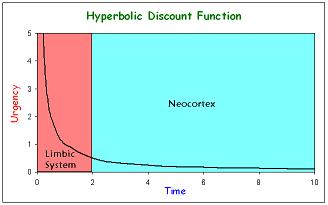
People who study human behavior have found something interesting called the “discount rate”. The discount rate basically measures the sense of urgency with which people view problems and compare it to how far into the future those problems will occur. If you look at the chart you'll see that people are extremely short sighted. We tend to only react to problems that are happening or are on the brink of happening. Our sense of urgency decreases dramatically, to near zero, whenever something is not imminent. We see this behavior all the time. Even when we hear a week in advance about a snow storm that is coming, most everybody rushes to the grocery store the day of the storm or the day before if they're ambitious. We simply aren't good at looking beyond the here and now. Carpe diem. I guess it's foolish of me to believe that, as a group, we would behave any different with our national debt crisis. It would also be foolish to believe that we'll realize we need to make drastic changes before it's too late. It might be too late already.
In the past few decades, Americans have come to have some unrealistic and conflicting expectations. Once the federal government started to provide for people, as opposed to creating a situation where people are capable of providing for themselves, the demand to be provided for has exploded.
We want everyone who gets a terminal disease to live another 30 years. We also want the government to keep our health care costs low. Somehow. Any way.
We cheer when government financial institutions guarantee loans so we can buy homes with no money down and low interest rates and then call on the government to help us out when we can no longer afford our homes. Somehow. Any way.
Nobody bats an eye when the federal government guarantees student loans that allow an 18-year-old to go $200,000 in debt so he or she can get a degree in Music Appreciation, Physical Education, or The Many Shades Of Concrete. And then we want the government to help us with our debt problems when we can't find a job that pays a sufficient salary to repay our loans. Somehow. Any way.
When credit card companies charge 20% interest, and suddenly that $500 PS3 is costing you $5,000, we cry to congress to pass a law to keep them from doing it instead of --gasp-- saving until we can afford that stuff. Then, when we have to get a payday loan at a pawn shop with even higher interest just to buy food or keep the lights on, we get pissed because credit isn't available and call on the government to help us out. Somehow. Any way.
We don't get upset when we spend trillions of dollars in order to fight never ending pseudo-wars, but get upset because we're trillions of dollars in debt and expect our government to fix the problem. Somehow. Any way.
We want the government to cure economic imbalances, but we want the medicine to taste good.
We twiddle our thumbs and grind our teeth while muttering "gosh, I don't like this but if they say we have to do it then I guess it's true" under our breath when the government props up a phony economy by giving trillions of dollars to corporations that made bad decisions and have no reason to exist anymore. Then after we give all that money to people who we recognize as corrupt and greedy scumbags, we act shocked and appalled when they use that bailout money to buy themselves an island or 2 in the pacific.
We want unemployment benefits, welfare for the poor, food stamps for half of us, wars in the middle east, low house prices when we buy, higher house prices sometime after that, medicare, medicaid, social security, cheap food, high wages, retirement at 60, low taxes, billions of gallons of oil, no oil spills, rules and regulations on oil companies when a spill happens, low oil prices, safe airplane travel, convenient airplane travel, some cake, our government to feed it to us too.
At some point we started to act like children, expecting the government to provide for us, no matter what the costs. Is it any wonder that we now have a government that treats us like children? Entitled brats with no motivation to expend any more energy than what is absolutely necessary to get by. We put as little effort into the system as possible, refusing to pick up a book and become educated on the issues, opting instead to trust those in charge (or worse yet, silently distrust them while sitting idly by) and let them do what they do. Less than half of us vote, which, by the way, is the lowest possible form of civic participation, and the vast majority of voters refuse to participate at any higher level. And then we complain when things go wrong, or more problems are created, or we find ourselves $14 trillion in debt with hundreds of trillions of dollars in unfunded liabilities.
The harsh reality is that we have a mountain of debt because we asked for a mountain of debt. We wanted to live like millionaires on a $40,000 salary and we have done just that for a few decades. Even those who are the most concerned about the debt problem don't want to have their programs cut. Get our spending in order, but don't take away my medicare or social security. Increase revenues to the government, but raise the other guy's taxes, not mine. Fix the problems, but don't make it painful.
Because we had this mindset for so long, we have reached a point where any meaningful solutions MUST be painful. Extremely painful. But I don't think Americans are ready to face the pain. We don't want to give up enough. We would much rather hear lip service from those in charge and believe the illusion that that is enough.
In the coming months we'll see some very telling and symbolic actions in congress. The 14.3 trillion dollar debt ceiling, set by congress, will be reached between March and May. Some congressmen are threatening to vote against raising the debt ceiling, essentially forcing congress to cut any spending beyond what we have in tax revenue. Cutting 1.3 trillion dollars a year in spending would force some very difficult decisions on congress. Austan Goolsbee, Obama's top economic adviser, said that failing to raise the debt ceiling would be the same as defaulting on our debt and would be catastrophic for the economy. In other words, if we don't go into more debt we can't pay off our current debt. In even other words, he admitted that we're running a gigantic ponzi scheme. Relying on new money to pay off the old money is the definition of a ponzi scheme.
He is right about everything, especially the catastrophic part. Getting on sound financial ground would mean a lot of pain to a lot of people. And because the people aren't willing to face that pain, congress will vote to raise the debt ceiling to protect its children from pain today and ensure that we'll face greater pain in the future. Of course, we'll still want lip service and empty promises to make it feel like something is being done. Many will vote to raise the debt ceiling under the condition that there are cuts in the budget. And we'll probably see spending cuts, but those cuts won't be able to cause too much pain to the people so they'll be extremely insignificant. We might see 50 or 70 billion dollars in cuts out of a 1.3 trillion dollar deficit. To put it simply, they'll put a band aid on a gunshot wound because surgery would be too painful. And it'll all be done because it's all we really want to bear.
People who study human behavior have found something interesting called the “discount rate”. The discount rate basically measures the sense of urgency with which people view problems and compare it to how far into the future those problems will occur. If you look at the chart you'll see that people are extremely short sighted. We tend to only react to problems that are happening or are on the brink of happening. Our sense of urgency decreases dramatically, to near zero, whenever something is not imminent. We see this behavior all the time. Even when we hear a week in advance about a snow storm that is coming, most everybody rushes to the grocery store the day of the storm or the day before if they're ambitious. We simply aren't good at looking beyond the here and now. Carpe diem. I guess it's foolish of me to believe that, as a group, we would behave any different with our national debt crisis. It would also be foolish to believe that we'll realize we need to make drastic changes before it's too late. It might be too late already.
At some point our budget problems will fuel a currency crisis and congress will run out of ways to kick the can down the road. Thomas Jefferson said that we needed a revolution every generation to keep the population from becoming complacent, apathetic and removed from the political system. We're many generations overdue for a revolution. When the currency crisis starts, so will our revolution. Maybe it'll happen in 2011. Maybe we can hold off until 2012. I doubt we can delay the inevitable any longer than that, no matter how much we want to. And it'll all be because we pay for what we feel we are entitled to today with money we hope we have in 10 years. Worse than that, we stand in the face of this harsh reality and try to convince ourselves that we can keep the scheme working. Somehow. Any way. If that doesn't sound like the mindset of a people that deserves to get splattered with shit from a fan, I don't know what does.
Subscribe to:
Posts (Atom)