Yay! We reached a debt ceiling agreement! And it cuts $2.1 trillion from the federal budget!
Let's take a closer look at what really happened.
First of all, there are guaranteed budget cuts of $2.1 trillion. Sounds great until you realize that those cuts are spread out over 10 years. What's worse is that those cuts are extremely back-end loaded, meaning that much of that money isn't cut until many years down the road. In fact, only about 20 or 25 billion dollars in cuts take effect in fiscal year 2012. As far as I'm concerned, those are the only cuts that matter because any future congress doesn't have to abide by the guidelines set out in this bill. (If you're curious, 2013 cuts amount to only $47 billion, but the new 2012 congress will likely change that.) This is why politicians love 10 year budgets. They can make seemingly huge cuts that only take place in the last 3 or 4 years, never actually follow through with those cuts 6 or 7 years later and claim victory in order to help their reelection chances. Oh, and those cuts aren't really cuts in any literal sense of the word. In Washington, if you plan to increase spending by 10% but only increase it by 6% they say they made a 4% budget cut, even though spending increases by 6%. These cuts are no different. They're only budget increases that are less than the larger budget increases that were already in place. Maybe that explains why so many politicians have a weight problem. "I only ate 7,000 calories today instead of the 10,000 I planned on eating! I cut my calorie intake by 30% and only gained 5 pounds instead of 8! This diet is a huge success!"
Now to the debt ceiling. I'm not entirely certain how much it is raised by. Initially it's $400 billion with another $500 billion increase later this year. And I also saw that the total increase would somehow end up being about $2.1 trillion. That's the largest number I've seen so I'll just assume that is true. This number is very important because it's the amount of money that the Treasury says they need in order to make it through the next election cycle and into 2013. In fact, Vice President Biden said that the deal has one overwhelming redeeming feature: postponing the next debt limit battle until 2013 and leaving the current fight behind. This is crucial because Obama, and anybody in congress for that matter, don't want to have to duke it out over the debt ceiling again before they have to hit the campaign trail.
But I'm not so sure that $2.1 trillion dollars is enough to get us by that long. In August of 2009 the White House predicted the 2011 GDP to increase by 3.8%. In July of 2010 the White House projected 2011 GDP to increase by 4%. Now that we have 2 quarters of data for 2011 let's see how accurate they were. The 1st quarter GDP was originally stated to be 1.9% but was recently revised down to 0.4%. Currently the 2nd quarter GDP increase is said to be 1.3% and who knows how much that will be revised down to.* But even if we have 0.4% Q1 GDP and 1.3% Q2 GDP, that still only gives us an annualized rate of 0.8%. That is just slightly more than a long fucking way from the 4% projected just one year ago (If you're keeping score at home, the White House was off by 400% IN JUST ONE YEAR**). And with an economy that looks more and more likely to slip into the double-dip recession*** that I've been expecting for over a year now (and I'm certain it is inevitable), I wouldn't be surprised if the real revenues fall far short of the projections and the deficit ends up being much larger than expected. If that happens, and it's very likely that it will****, the Treasury could burn through their $2.1 trillion ceiling hike much sooner than anyone believes. Reaching the debt limit again, before the 2012 election, would pretty much be the nail in Obama's coffin. Then we will elect a Republican that is just as ineffective. Yay!
*Q1 GDP was revised down by 1.5%. If Q2 is revised down that much we will officially be in negative growth territory. Just a reminder, back in August 2010 I predicted GDP to enter negative growth by Q2 2011. In a few months, when the official Q2 GDP numbers are revised, that could prove to be amazingly accurate. Either way, the fact that some dumb fuck with no formal economics education who can read and objectively take in information has made predictions much more accurate than the President from Harvard speaks volumes.
**If they can be off by so much in just one year, why does anyone expect them to make budget and revenue forecasts that go out 10 years? Am I the only one who thinks this is insanity?
***In this case the term "double dip recession" is somewhat of a misnomer. It's my belief that we're currently in a depression that's been going on since 2007. The only reason the GDP numbers are positive is because the government is manipulating CPI to make inflation seem much lower than it is. Remember, official GDP is the increase in nominal GDP minus the inflation rate. If we had an accurate inflation rate, it would be high enough to push official GDP into negative territory.
****Since we'll probably have QE3 in the next couple months, and almost certainly will by the end of the year, that could help keep the economy afloat even though the effects of QE will be less and less with each round. But remember, when The Fed does QE, they print money to purchase Treasuries, so the QE money will go towards the national debt and, obviously, the debt ceiling.
Wednesday, August 3, 2011


Tuesday, June 21, 2011
No Love For Democracy
Pretty much every day you'll hear, in some for or another, the virtues of democracy being espoused. Most notably, this sentiment is expressed when we justify our overseas wars. "We are making the world safe for democracy" is a phrase that's been thrown at us for decades now. It's accepted that governments have the ability to enslave and restrict freedoms to their citizens, the only variable being the degree to which they do those things. Enough dictators and despots throughout history have certainly proven this fact. It is also accepted that simply having a democratic form of government is enough to ward off these evil tendencies of governments and ensure that people remain free. It's why we fight wars that “bring freedom and democracy to a nation.” But very little discussion is actually had on the virtues and implications of democracy.
It is generally accepted that with democracy comes freedom. This is something we all seem to understand without even giving it any thought. In a democratic society, the will of the people will prevail and surly that is emblematic of freedom itself. So long as democracy is allowed, it will ensure that freedom is upheld. Majority rule is clearly the most moral form of government one can aspire to. Perhaps these are the generally accepted beliefs, but those beliefs are wrong. In fact, I'll go one step further and posit that the only difference between a totalitarian government and a democratic government is that a dictator is simply replaced with a majority. More specifically, a voting majority.
When you get down to the basics of democracy, it's clear that it is nothing more than a system whereby the majority is legally able to impose their will on the minority. Not only does this not guarantee freedom, but it almost ensures that freedom will not exist. The only question is to what extent will freedom be forbidden.
One needs not look further than present day America to see the immoral effects of democracy. We have laws that forbid the use of recreational drugs because the majority has voted politicians into office that made that behavior illegal. Does freedom enter into this decision at all? Certainly not. If 55% of the population doesn't approve of the use of certain drugs, they can simply use the democratic process and summon the coercive power of government to impose their will on the other 45%. While there is nothing undemocratic about this, there certainly is, in my opinion, something extremely immoral with it.
There are a whole host of issues where, simply because something is not popular, it is made illegal and therefor limits the freedom of individuals to engage in certain behavior. Personally, I feel that prostitution is abhorrent behavior. But my personal opinion on the matter should not give me the ability to use government to prevent others, people who might not hold the same opinion as I do, from engaging in that activity. Why should I have the ability to use the power of government to impose my will on those who disagree with me? Why should the legality of certain behavior depend on popular opinion? Why should anyone's freedom to engage in behavior that causes no direct harm to others be restricted simply because most of his neighbors voted to do so? Why should someone be forced to give up half of their earnings to a man with a gun and a cage simply because The Majority approves of it? The answer is simple: Because we have democracy, and restricting the behavior of others can be done whenever a majority supports it.
And yet most of us hoist democracy onto a pedestal. Even worse, we put freedom right next to it. It seems to me that freedom and democracy are not inherently compatible. And why should they be? Democracy is the will of the majority. But that's only the first half of the definition. If we're being honest, democracy is the will of the majority imposed on the minority with force and the threat of violence. That has nothing to do with freedom. Freedom is something that everyone espouses, few people understand, and even fewer people desire. The proof lies in our democratic government, our willingness and ability to vote ourselves other people's money and our incessant need to use the democratic process to restrict behavior simply because We The Majority don't approve of it.
Forgive me if I retain the pedestal for something more deserving.
Monday, May 23, 2011
Deflation, Oh No!
So it's starting to happen. A few weeks ago commodities got pounded, oil and silver especially. And now stocks are falling rather sharply. It looks like the market is starting to price in the end of QE2 as $6 billion of cash flooding the system every day courtesy of the Federal Reserve will be ending in just over a month. Without this economic life support, we can expect to see deflation rear its ugly head again over the summer as the market desperately tries to cure itself of government created disease. Of course, once people start to see the value of their 401k fall through the floor, housing double dips to new lows, interest rates rise to unacceptable levels and our pathetic job creation ability comes to an end everyone will beg Ben Bernanke to start QE3. And why not? The first two rounds worked so wonderfully, right? As Jim Rogers said, "The money printer will print money." We won't be twisting Bernanke's arm a whole lot before he obliges us.
Expect to see the S&P drop about 20% before Ben is justified in unleashing his Helicopter full of cash. September. Maybe October.
Expect to see the S&P drop about 20% before Ben is justified in unleashing his Helicopter full of cash. September. Maybe October.
Helping The Unemployed While Growing The Economy (An Easy Solution To Our Predicament)
I still find it fascinating that politicians can't seem to grow the economy. Even though many of them realize how it works, political theater and partisan politics always seems to get in the way. For anyone who doesn't yet understand it, I'll take some time to explain it so you can see how easy it is.
Let's say Bob is unemployed. All we need to do is have the government give Bob some money, say $150. Now Bob can take that $150 and buy a TV from Mike. Mike, being a wealthy businessman, will then pay $100 in taxes and he can be allowed to add the other $50 to his vast fortune. Now, since Bob bought an energy efficient TV, the government can give him a $50 rebate for making a wise choice. Add that $50 to the $100 in taxes that Mike paid and the government can then give Bob another $150 for his unemployment check the next week.
Bob can then take that $150 and buy a bike from Jack. Again, Jack is a wealthy man so he will pay $100 in taxes and get to keep $50 to add to his wealth. Since Bob is making the correct decision in riding a bike instead of driving a gas powered vehicle, he will receive another $50 rebate so he can get another $150 for his unemployment check the following week.
Now Bob has a TV, a bike and $150 having started out with nothing. So what does he do? Well, he takes that $150 and he buys a radio from Sam and a week later he gets another $150 unemployment check from the government. So now he has a TV, a bike, a radio and $150 after starting out with nothing. And because of this process, Sam, Jack and Mike all saw an increase in demand for their products and the economy grew as a result. This is just a win-win-win situation all around and it's exactly how we need to grow ourselves out of this mess we're in.
And hopefully at some point Sam, Jack and Mike can all go broke on their investments so that they can be unemployed as well and start collecting unemployment checks so the economy can grow even faster with all the extra aggregate demand the government would be producing.
Hopefully everyone reading this recognized the satire and sarcasm, but it is almost exactly the way many of our politicians understand economics.
Let's say Bob is unemployed. All we need to do is have the government give Bob some money, say $150. Now Bob can take that $150 and buy a TV from Mike. Mike, being a wealthy businessman, will then pay $100 in taxes and he can be allowed to add the other $50 to his vast fortune. Now, since Bob bought an energy efficient TV, the government can give him a $50 rebate for making a wise choice. Add that $50 to the $100 in taxes that Mike paid and the government can then give Bob another $150 for his unemployment check the next week.
Bob can then take that $150 and buy a bike from Jack. Again, Jack is a wealthy man so he will pay $100 in taxes and get to keep $50 to add to his wealth. Since Bob is making the correct decision in riding a bike instead of driving a gas powered vehicle, he will receive another $50 rebate so he can get another $150 for his unemployment check the following week.
Now Bob has a TV, a bike and $150 having started out with nothing. So what does he do? Well, he takes that $150 and he buys a radio from Sam and a week later he gets another $150 unemployment check from the government. So now he has a TV, a bike, a radio and $150 after starting out with nothing. And because of this process, Sam, Jack and Mike all saw an increase in demand for their products and the economy grew as a result. This is just a win-win-win situation all around and it's exactly how we need to grow ourselves out of this mess we're in.
And hopefully at some point Sam, Jack and Mike can all go broke on their investments so that they can be unemployed as well and start collecting unemployment checks so the economy can grow even faster with all the extra aggregate demand the government would be producing.
Hopefully everyone reading this recognized the satire and sarcasm, but it is almost exactly the way many of our politicians understand economics.
Sunday, May 15, 2011
Today's Record LOW Gas Price
Over the past several weeks there has been a ton of reports about the high price of gas. Right now I would have to fork over nearly four dollars just to buy one gallon of gas. And it's true, if you're paying for gas in dollars, the price is almost at a record high. But I bet you haven't heard anything about how today's price of gas is at a record low. In reality, gas has never been cheaper in America. The problem is that in order to enjoy these record low prices you'll have to pay for that gas with real money, which the government quit issuing a few decades ago.
Before 1965 the government issued quarters and dimes that were made out of 90% pure silver. Before 1968 a dollar bill was really a silver certificate. That is, you could bring that bill to a Federal Reserve branch and get an ounce of silver in return. A quarter was made out of 1/4 ounce of silver and a dime was made out of 1/10 ounce of silver.* Today the coins are made out of whatever metal happens to be the cheapest and is then coated with another cheap metal to give it a silver color, making them have almost no intrinsic value. If someone asked for a quarter and you gave them a couple grams of copper and nickel that was worth 5.7 cents, I doubt that they would accept it, which is odd because that's all a quarter is. As for dollar bills, we don't even have those any more. What we have are Federal Reserve Notes, which are basically green pieces of paper that are backed by government debt. If you don't believe me then just take any bill out of your wallet and read the top of it. If you bring a FRN to a Federal Reserve branch and ask for anything in return they'll laugh in your face. Modern money in all its glory!
But back to the record low gas price. In 1931 the price of gas hit the all-time low price of about 17 cents per gallon. But remember, our money at that time was, quite literally, gold and silver. Now suppose you have a dime that was minted before 1965. You could take that coin to your local precious metal store and exchange it for about $3.50, since silver is currently at about $35/ounce. You could then drive to a gas station and get nearly a gallon of gas with those FRN's that a single dime bought you. In fact, if you paid for gas with those silver coins, gas would only cost you about 11 cents a gallon.**
What has happened here is obvious to anyone who cares to think about it. It's not the price of gas that is soaring. It's the value of the Federal Reserve Notes that are plummeting, causing you to fork over more of them just to buy the same amount of gas.*** We don't need presidential investigations or a special task force to understand why prices are rising, we just need to understand what money really is. Sadly, those of us that do understand this and, consequently, would like to return to a gold standard, are viewed in the same light as people who claim to have seen Elvis in a Tennessee truck stop, have a story about being abducted by aliens or harbor a rabid desire to blow up government buildings after spending a couple decades of isolation in a two-room shanty in Montana.
I think it's time to stop complaining about high gas prices and start complaining about the Federal Reserve purposely devaluing the money we use to buy gas. And Justin Bieber. Seriously.
*Actually, since they're only 90% silver they don't actually contain 1/10 an ounce of silver. I'm oversimplifying a little bit to avoid explaining a whole bunch of pointless math, but doing so doesn't alter my point. Feel free to do the math yourself.
**Interesting fact here. Today's price of gas is $3.90, and measured in depression-era currency it's $0.11. Do the math and you'll see that is a 97% difference. That's exactly how much the value of a dollar has declined since the Federal Reserve was instituted in 1913. This is no coincidence.
***One reason those on the political left who are more passionate about combating the widening wealth gap and, at least on a surface level, want to directly aide the poor, should support the gold standard is that the inflation of the monetary supply disproportionately benefits the most wealthy in society. When new money is created, the wealthiest people get it first. That means they get the benefits of spending or investing this new money before the monetary inflation causes prices to rise. Once the inflation eventually benefits poorer people in the form of higher wages, the prices have already risen, meaning that their income doesn't necessarily go up in real terms.
Monday, May 9, 2011
Interest Rates: How Interesting
Back in the olden days, in the long long ago, before about 1913, we didn't have a monopolistic cartel of private banks headed by a few unelected officials who were in charge of the nation's (and, more recently, the world's) money supply. But, other than money supply, another great power of the Federal Reserve is to dictate interest rates, either directly or indirectly. It's this power that gives us nearly every economic boom (Read: Bubble) because the central bank loves to keep interest rates too low for too long, thereby creating excess credit that eventually funnels into a single area and creates a bubble. But what would the world be like if Bernanke couldn't control interest rates? Well, this thing called the "free market" could take care of that. And it's actually pretty simple.
In a truly free market the interest rate would be determined by the amount of savings. When someone deposits money into a savings account, what they're essentially saying is that they are going to under-consume today so that they can consume more in the future. If enough people do this, and the amount of deposits on the bank's book increases, banks will lower interest rates. This lowering of interest rates does two things. First, it makes it cheaper for businesses to borrow money, thereby encouraging it. After all, interest is simply the cost of money. Lower interest rates can make a huge difference to a business that plans on investing a lot of money that won't start to turn profits for many years. Think of R&D departments that attempt to invent new technologies that won't be sold in a store for 10 or 20 years. The difference between 5% and 4% could be millions and millions of dollars. So as savings are build up, interest rates go down and long term investments become feasible. This works out wonderfully because the money that is being used to finance these long term investments that don't pay off until some future date is the very savings that people put away in order to be able to consume something in the future. This consistency in the time factor cannot be stressed enough. Not until people decide to consume in the future (save) can business start to invest in their future (borrow).
The second thing lower interest rates do is discourage savings. If you're only gaining 2% on a savings account you're going to save a lot less than when you were getting, say, 5%. This allows the banks to lend out their deposits, which is how they make most of their money. Once most of the deposits are lent out, the banks will need to start raising interest rates. This will encourage more savings and allow banks to rebuild their deposits at the same time that it discourages borrowing. Again, the time factor works out perfectly here. As people are consuming more today, it becomes harder for a business to invest in the future. This cycle continues with the competition between banks, saving habits of the individual and borrowing needs of business all working together to determine the interest rate.
But like I said, that system died a long time ago. How wonderful that we progressed enough to cast away those quaint relics of yesteryear. That awful era where unintelligent rubes didn't have the know-how to properly manage a nation's economy, money and credit. At least now we realize that we simply need the right people in charge. And as long as we just allow those brilliant economic planners to turn the dials the perfect amount and press the right buttons in the proper sequence we'll be alright. They'll give us the perfect amount of credit and just the right level of money supply. The waste and inefficiency of saving can be eliminated without effecting the ability of business to borrow and invest. I don't see how this could possibly go wrong...
In a truly free market the interest rate would be determined by the amount of savings. When someone deposits money into a savings account, what they're essentially saying is that they are going to under-consume today so that they can consume more in the future. If enough people do this, and the amount of deposits on the bank's book increases, banks will lower interest rates. This lowering of interest rates does two things. First, it makes it cheaper for businesses to borrow money, thereby encouraging it. After all, interest is simply the cost of money. Lower interest rates can make a huge difference to a business that plans on investing a lot of money that won't start to turn profits for many years. Think of R&D departments that attempt to invent new technologies that won't be sold in a store for 10 or 20 years. The difference between 5% and 4% could be millions and millions of dollars. So as savings are build up, interest rates go down and long term investments become feasible. This works out wonderfully because the money that is being used to finance these long term investments that don't pay off until some future date is the very savings that people put away in order to be able to consume something in the future. This consistency in the time factor cannot be stressed enough. Not until people decide to consume in the future (save) can business start to invest in their future (borrow).
The second thing lower interest rates do is discourage savings. If you're only gaining 2% on a savings account you're going to save a lot less than when you were getting, say, 5%. This allows the banks to lend out their deposits, which is how they make most of their money. Once most of the deposits are lent out, the banks will need to start raising interest rates. This will encourage more savings and allow banks to rebuild their deposits at the same time that it discourages borrowing. Again, the time factor works out perfectly here. As people are consuming more today, it becomes harder for a business to invest in the future. This cycle continues with the competition between banks, saving habits of the individual and borrowing needs of business all working together to determine the interest rate.
But like I said, that system died a long time ago. How wonderful that we progressed enough to cast away those quaint relics of yesteryear. That awful era where unintelligent rubes didn't have the know-how to properly manage a nation's economy, money and credit. At least now we realize that we simply need the right people in charge. And as long as we just allow those brilliant economic planners to turn the dials the perfect amount and press the right buttons in the proper sequence we'll be alright. They'll give us the perfect amount of credit and just the right level of money supply. The waste and inefficiency of saving can be eliminated without effecting the ability of business to borrow and invest. I don't see how this could possibly go wrong...
Sunday, April 10, 2011
Debt Ceiling, Default And Teleporters
With all the budget talks lately, the fact that we are quickly approaching the debt ceiling is slipping under the radar. But we'll hit our debt target in about a month, maybe 6 weeks, and then congress will be forced to raise that limit. That the debt limit will get raised is a guarantee, the only question is how much it will get raised.
The pundits on TV will tell you that we need to raise the debt ceiling because failing to do so will destroy our bond market, raise interest rates and ultimately cause us to default on our debt. The problem is that all of those things are going to happen anyway. Guaranteed. Sure, there are things that government can do (and they have been doing these things for years) to put off this inevitability into the future. But the longer we delay these problems, the worse they will become.
Anybody who thinks we won't default on our debt is either a lunatic, drunk or both. So if we will not pay back our debt, we must default on it. There are two ways that governments can do this. First, they can be honest about the situation and restructure the debt. They can get their budget in order and then make deals with their lenders where they don't get paid 100% of their loans but at least they get paid in money that has some value. The problem is that the budget need to be balanced for this to work. We almost saw a government shutdown because politicians couldn't agree on whether to cut $30 billion or $60 billion. OUT OF A $1.6 TRILLION YEARLY DEFICIT! On my most optimistic day I can imagine a scenario where we try really hard and our politicians are willing to fight for a balanced budget and we'll maybe see one in 15 or 20 years. Even if that would happen, it's not nearly soon enough. I don't think we have 5 years before the system breaks down. So option 1 is out the window.
The second way to default on the debt is to inflate it away. That is, we simply print new money to pay our debts. Our lenders will get their money, but they will be paid in money that is worth much less than the money they lent us. This is the worst option, but it's becoming clear that it is the option we'll take. As long as the debt ceiling continues to be raised, as long as interest rates stay extremely low, as long as the Fed is willing to print money to monetize our debt, and as long as someone is willing to lend us money at the low interest rates this is what we will do.
But that option can only work so long as all of those things stay true. Once one of those factors goes away, the bubble will pop, interest rates will skyrocket, the dollar will plummet, we will default on our debt and hyperinflation becomes a real threat. Notice that the end result of that scenario is nearly identical to the end result of not raising the debt ceiling right now. Like I said, all of those things are going to happen sooner or later. The only option we have is whether we want to face the problems today, take the medicine and deal with the pain (and trust me, it will be very painful), or keep delaying the problem until it's impossible to do so any longer and in the meantime pray for some new technology or invention (like a teleporter for example) that completely changes the nature of our economy. Barring a new, revolutionary technology, the end result of this option is only a deeper and more painful recession/depression than what we would have to face right now.
The pundits on TV will tell you that we need to raise the debt ceiling because failing to do so will destroy our bond market, raise interest rates and ultimately cause us to default on our debt. The problem is that all of those things are going to happen anyway. Guaranteed. Sure, there are things that government can do (and they have been doing these things for years) to put off this inevitability into the future. But the longer we delay these problems, the worse they will become.
Anybody who thinks we won't default on our debt is either a lunatic, drunk or both. So if we will not pay back our debt, we must default on it. There are two ways that governments can do this. First, they can be honest about the situation and restructure the debt. They can get their budget in order and then make deals with their lenders where they don't get paid 100% of their loans but at least they get paid in money that has some value. The problem is that the budget need to be balanced for this to work. We almost saw a government shutdown because politicians couldn't agree on whether to cut $30 billion or $60 billion. OUT OF A $1.6 TRILLION YEARLY DEFICIT! On my most optimistic day I can imagine a scenario where we try really hard and our politicians are willing to fight for a balanced budget and we'll maybe see one in 15 or 20 years. Even if that would happen, it's not nearly soon enough. I don't think we have 5 years before the system breaks down. So option 1 is out the window.
The second way to default on the debt is to inflate it away. That is, we simply print new money to pay our debts. Our lenders will get their money, but they will be paid in money that is worth much less than the money they lent us. This is the worst option, but it's becoming clear that it is the option we'll take. As long as the debt ceiling continues to be raised, as long as interest rates stay extremely low, as long as the Fed is willing to print money to monetize our debt, and as long as someone is willing to lend us money at the low interest rates this is what we will do.
But that option can only work so long as all of those things stay true. Once one of those factors goes away, the bubble will pop, interest rates will skyrocket, the dollar will plummet, we will default on our debt and hyperinflation becomes a real threat. Notice that the end result of that scenario is nearly identical to the end result of not raising the debt ceiling right now. Like I said, all of those things are going to happen sooner or later. The only option we have is whether we want to face the problems today, take the medicine and deal with the pain (and trust me, it will be very painful), or keep delaying the problem until it's impossible to do so any longer and in the meantime pray for some new technology or invention (like a teleporter for example) that completely changes the nature of our economy. Barring a new, revolutionary technology, the end result of this option is only a deeper and more painful recession/depression than what we would have to face right now.
Saturday, March 12, 2011
American Foreign Policy: The Flow Chart
I know it's difficult at times to wrap your head around the foreign policy decisions that American leadership makes, so I've devised this handy flow chart to help makes some sense of it. Hopefully this helps to clear up some of the misunderstandings. (Click the image to make it larger)


Monday, March 7, 2011
Quantitative Easing: To Infinity And Beyond
Since the Great Recession started a couple years ago*, the federal reserve has been involved in a process called "Quantitative Easing". I've discussed this before so I won't go into the process any further. The second round of Quantitative Easing, QE2, is set to expire at the end of June. Watch the talking heads on TV and they'll tell you, almost unanimously, that there will be no further rounds of QE. Their reasoning is that the economy is turning around. I think the economy only appears to be turning around because of the QE, and the recovery isn't sustainable without it. Either my laymen understanding of our economic condition is terribly wrong, or these guys are grossly stupid. I have a very healthy ego so I'm going to go with the latter. Here's why I think that QE3, QE4, QE5, etc will happen.
As I mentioned in the article I linked above, the federal government is running huge deficits, and will be doing so for at least the next decade. This means that the treasury has to sell bonds to cover the budget deficits. Since QE2, the federal reserve has been buying 70% of new treasury bonds. When QE2 ends, and the fed stops buying treasuries, someone has to pick up the slack. And that's a lot of slack.
You might be thinking that China will come to the rescue again, but I don't think they can continue to do that. When they buy our treasuries, they have to print money to do so, which causes inflation. They're already experiencing a high level of inflation, possibly as much as 10% or more. They're currently importing much of our inflation in order to keep their currency pegged to our dollar. But the inflation problem in China (and all over the world really) is leading to some civil unrest that The State needs to avoid. As we've recently seen in the Middle East, citizens will put up with brutal regimes as long as they have a job and can afford food. By printing money, we're pushing up the price of food all over the world, China included.** In order to get their inflation under control and calm the citizenry, China is going to have to stop buying our debt with money they print.
So if not China, then who? That's a very good question. A better question might be How much interest are these unknown buyers going to charge? Since the fed represents 70% of bond demand, once they quit buying bonds the demand will drop and interest rates will surge. If interest rates go up significantly, the federal government is going to have to find more buyers of our debt to cover the higher amount in interest payments plus the new debt we take on. Finding more buyers of this debt in a market where demand is low will push interest rates up higher, which will cause us to have to find even more buyers who will demand higher interest which will cause us to find even more buyers which will... well, you get the idea. It's called a Ponzi Scheme, and even Bernie Madoff recognizes that our entire government operates as one. If there are no buyers of our debt other than the federal reserve, the federal reserve will be forced into filling that gap in order to keep interest rates low.
Another problem is that the economy cannot sustain the "growth" we've experience over the past 6 months or so without the money that the fed is providing through QE2. On average, the federal reserve has been purchasing 5-8 billion dollars of treasuries a day and injecting that new money into the system. This has been great news for stocks since the vast majority of that money makes its way to the big guys on Wall Street. Ever since "Jackson Hole" late last August, when the fed announced their plan for QE2, stocks have almost gone straight up***. Before that, the economy was in shambles in the vacuum left behind after QE1. Things aren't much different now than they were last summer. Many of our problems have not been fixed and most of the ones that matter are even worse today. Once the fed stops pumping money into the economy, the "recovery" will sputter and there will be a lot of pressure on them to fire up the printing press.
There is a problem though. The public is becoming more and more nervous about all of the money printing. Luckily for Washington, the public is also easily manipulated.If QE3 happ When QE3 happens, they can do it without calling it that officially. QE2 is written in such a way that it can be expanded upon if the fed chooses to do so. That means that we do another round of Quantitative Easing but call it a continuation of QE2, or some other goofy name altogether. It will also be interesting to see what tragedy or crisis they say we are on the brink of in order to convince the public that it is necessary. I'm of the mindset that we're already on the brink of an economic depression if we stop the QE(insert number). But as I've said before, that is an inevitability that is only being delayed and intensified by the actions of the federal reserve. If we continue on this QE/huge deficit spending path, we're almost guaranteeing that we experience hyperinflation and a total economic collapse. The sooner we try to deal with the mess in a real and honest way, the better. 2008 would have been a nice time to start...
*Fun fact: The Great Recession officially ended in September 2010. That's according to Government Data though. Mark Twain popularized the phrase "There are lies, damned lies, and statistics." Today that phrase would be "There are lies, damned lies, statistics, and government statistics."
**Because we have the world's reserve currency, food is traded in US dollars in the world markets. When we print 2 trillion dollars to prop up our economy, we also bring the price of food up across the world. These Mid-East protests can be directly linked to our inflationary monetary policy. If it spreads to Saudi Arabia, I hope you can afford $5(probably even more) gas
*** This chart shows the DOW from a couple weeks before the announcement of QE2 (end of August) until now. Stocks were falling until the minute QE2 was announced. Wall Street loves free money from the fed.

As I mentioned in the article I linked above, the federal government is running huge deficits, and will be doing so for at least the next decade. This means that the treasury has to sell bonds to cover the budget deficits. Since QE2, the federal reserve has been buying 70% of new treasury bonds. When QE2 ends, and the fed stops buying treasuries, someone has to pick up the slack. And that's a lot of slack.
You might be thinking that China will come to the rescue again, but I don't think they can continue to do that. When they buy our treasuries, they have to print money to do so, which causes inflation. They're already experiencing a high level of inflation, possibly as much as 10% or more. They're currently importing much of our inflation in order to keep their currency pegged to our dollar. But the inflation problem in China (and all over the world really) is leading to some civil unrest that The State needs to avoid. As we've recently seen in the Middle East, citizens will put up with brutal regimes as long as they have a job and can afford food. By printing money, we're pushing up the price of food all over the world, China included.** In order to get their inflation under control and calm the citizenry, China is going to have to stop buying our debt with money they print.
So if not China, then who? That's a very good question. A better question might be How much interest are these unknown buyers going to charge? Since the fed represents 70% of bond demand, once they quit buying bonds the demand will drop and interest rates will surge. If interest rates go up significantly, the federal government is going to have to find more buyers of our debt to cover the higher amount in interest payments plus the new debt we take on. Finding more buyers of this debt in a market where demand is low will push interest rates up higher, which will cause us to have to find even more buyers who will demand higher interest which will cause us to find even more buyers which will... well, you get the idea. It's called a Ponzi Scheme, and even Bernie Madoff recognizes that our entire government operates as one. If there are no buyers of our debt other than the federal reserve, the federal reserve will be forced into filling that gap in order to keep interest rates low.
Another problem is that the economy cannot sustain the "growth" we've experience over the past 6 months or so without the money that the fed is providing through QE2. On average, the federal reserve has been purchasing 5-8 billion dollars of treasuries a day and injecting that new money into the system. This has been great news for stocks since the vast majority of that money makes its way to the big guys on Wall Street. Ever since "Jackson Hole" late last August, when the fed announced their plan for QE2, stocks have almost gone straight up***. Before that, the economy was in shambles in the vacuum left behind after QE1. Things aren't much different now than they were last summer. Many of our problems have not been fixed and most of the ones that matter are even worse today. Once the fed stops pumping money into the economy, the "recovery" will sputter and there will be a lot of pressure on them to fire up the printing press.
There is a problem though. The public is becoming more and more nervous about all of the money printing. Luckily for Washington, the public is also easily manipulated.
*Fun fact: The Great Recession officially ended in September 2010. That's according to Government Data though. Mark Twain popularized the phrase "There are lies, damned lies, and statistics." Today that phrase would be "There are lies, damned lies, statistics, and government statistics."
**Because we have the world's reserve currency, food is traded in US dollars in the world markets. When we print 2 trillion dollars to prop up our economy, we also bring the price of food up across the world. These Mid-East protests can be directly linked to our inflationary monetary policy. If it spreads to Saudi Arabia, I hope you can afford $5(probably even more) gas
*** This chart shows the DOW from a couple weeks before the announcement of QE2 (end of August) until now. Stocks were falling until the minute QE2 was announced. Wall Street loves free money from the fed.

Wednesday, March 2, 2011
Defending Evil
"You see, that's the whole point of being the government. If you don't like something you simply make up a new law that makes it illegal"
-Minister Dormandy in Pirate Radio
Just today the Supreme Court ruled in favor of a bunch of despicable people at the Westboro Baptist Church. For anyone living under a rock for the past few years, the people at Westboro do awesome things like protest at soldiers' funerals. Their logic is this:
1) God hates gays.
2) America is far too tolerant to gays.
3) God wants to punish America for being too tolerant of gays.
4) God kills soldiers as punishment for America's tolerance of gay people.
Yeah, they're juuuuuust a little goofy.
Back to the Supreme Court ruling. A family member of one of these soldiers sued Westboro and it eventually ended up at the Supreme Court who ruled 8-1 in favor of the protesters. It's my opinion that the only bad thing about this ruling is that it wasn't unanimous.
In America we like to talk about our "rights" "liberties" and "freedom". Those are all noble ideas and concepts that we all embrace... when it's easy. This is one of those cases where it's not easy. A family in mourning had to bury a man while a group of hateful assholes celebrated it. But their celebration occurred 1,000 feet away (far enough away that those at the funeral couldn't see them, and in compliance with city ordinance) and on public land. In my opinion those are all reasonable conditions to limit speech so that it doesn't interfere with the right of other people to be left alone.
But in a case like this it's far too easy to get caught up in the emotion and lunacy of the whole thing and look for ways to keep people from saying things that we disagree with. Any reasonable person would recognize Westboro's actions as something that is not desirable. But that should not give us the right to make it illegal or further limit it in some way. I fear that the opposite ruling of the Supreme Court, had it occurred, would not have elicited much outrage among American's who claim to embrace free speech. The reason is simple: because it's difficult to defend such horrible speech. Shouldn't the right to speak freely be defended the most when the speech is outside of our comfort zone since that's when it's most likely to be attacked?
If we only defend free speech (or any other "right" for that matter) when it's easy and when we agree with the speech, then we don't really defend speech at all. We simply defend speech that we agree with, or isn't offensive, or isn't controversial. Free speech should not have an asterisk next to it.
I think you can tell a lot about a man's character based on whether or not he is willing to, based on principle, defend something with which he fervently disagrees. I don't think American's would have rushed to the defense of Westboro Baptist if the Court ruled the other way, and hopefully I'm wrong about that. Thankfully they got this one right.
-Minister Dormandy in Pirate Radio
Just today the Supreme Court ruled in favor of a bunch of despicable people at the Westboro Baptist Church. For anyone living under a rock for the past few years, the people at Westboro do awesome things like protest at soldiers' funerals. Their logic is this:
1) God hates gays.
2) America is far too tolerant to gays.
3) God wants to punish America for being too tolerant of gays.
4) God kills soldiers as punishment for America's tolerance of gay people.
Yeah, they're juuuuuust a little goofy.
Back to the Supreme Court ruling. A family member of one of these soldiers sued Westboro and it eventually ended up at the Supreme Court who ruled 8-1 in favor of the protesters. It's my opinion that the only bad thing about this ruling is that it wasn't unanimous.
In America we like to talk about our "rights" "liberties" and "freedom". Those are all noble ideas and concepts that we all embrace... when it's easy. This is one of those cases where it's not easy. A family in mourning had to bury a man while a group of hateful assholes celebrated it. But their celebration occurred 1,000 feet away (far enough away that those at the funeral couldn't see them, and in compliance with city ordinance) and on public land. In my opinion those are all reasonable conditions to limit speech so that it doesn't interfere with the right of other people to be left alone.
But in a case like this it's far too easy to get caught up in the emotion and lunacy of the whole thing and look for ways to keep people from saying things that we disagree with. Any reasonable person would recognize Westboro's actions as something that is not desirable. But that should not give us the right to make it illegal or further limit it in some way. I fear that the opposite ruling of the Supreme Court, had it occurred, would not have elicited much outrage among American's who claim to embrace free speech. The reason is simple: because it's difficult to defend such horrible speech. Shouldn't the right to speak freely be defended the most when the speech is outside of our comfort zone since that's when it's most likely to be attacked?
If we only defend free speech (or any other "right" for that matter) when it's easy and when we agree with the speech, then we don't really defend speech at all. We simply defend speech that we agree with, or isn't offensive, or isn't controversial. Free speech should not have an asterisk next to it.
I think you can tell a lot about a man's character based on whether or not he is willing to, based on principle, defend something with which he fervently disagrees. I don't think American's would have rushed to the defense of Westboro Baptist if the Court ruled the other way, and hopefully I'm wrong about that. Thankfully they got this one right.
Thursday, February 17, 2011
Optimistic, Unrealistic Budget
President Obama recently released his budget proposal for next year and it is quite fantastic. It includes revenue increases of 65% and will reduce the deficit from 11% of GDP to 3.2% of GDP. It's wonderful! Fast track this through congress and start looking for retirement islands in the Caribbean! OK, maybe I'm being a little too sarcastic. Instead of caustic hyperbole and snarky rhetoric, I'll use some data and facts to let you know why this budget is a farce.
Here are the specifics of the recently released budget proposal (Source):
FY 2011 Projected Revenue: $2.174 Trillion
FY 2011 Projected Spending: $3.819 Trillion
FY 2011 Projected Deficit: $1.645 Trillion
Spending as % of GDP: 25.3%
Deficit as % of GDP: 10.9%
FY 2012 Projected Revenue: $2.627 Trillion
FY 2012 Projected Spending $3.729 Trillion
FY 2012 Projected Deficit: $1.101 Trillion
Spending as % of GDP: 23.6%
Deficit as % of GDP: 7.0%
FY 2013 Projected Revenue: $3.003 Trillion
FY 2013 Projected Spending: $3.771 Trillion
FY 2013 Projected Deficit: $768 Billion
Spending as % of GDP: 22.5%
Deficit as % of GDP: 4.6%
FY 2014 Projected Revenue: $3.333 Trillion
FY 2014 Projected Spending: $3.977 Trillion
FY 2014 Projected Deficit: $645 Billion
Spending as % of GDP: 22.4%
Deficit as % of GDP: 3.6%
FY 2015 Projected Revenue: $3.583 Trillion
FY 2015 Projected Spending: $4.190 Trillion
FY 2015 Projected Deficit: $607 Billion
Spending as % of GDP: 22.3%
Deficit as % of GDP: 3.2%
First, let's look at the 65% projected increase in revenue. Has this large of an increase in revenue ever occurred in such a short period of time? The answer is yes, but it comes with an asterisk or two.
Over the past 60 years there have only been three other years with a similar rate of revenue growth for a 4 year period (where each year is compared to the revenue period four years prior). They happened in 1979, 1980 and 1981. Those years also happen to have some of the highest rates of inflation in the 50 or so years of data. To be specific, 1979 had the 2nd highest inflation (11.3%), 1980 had the 1st highest (13.5%) and 1981 had the 4th highest (10.4%). Obama's budget doesn't assume those enormous inflation levels. In fact, it assumes 2% or less inflation, so it's not inflation that will be driving the enormous revenue growth.*
Another reason we could have a 65% increase in revenue would be because of a huge expansion of GDP. Again, in 1979, 1980 and 1981 we saw extremely high GDP growth of 11.7%, 8.8% and 12.1% respectively. Out of 65 years of data those are the 4th, 5th and 17th fastest years of economic expansion. Does the Obama budget expect similar GDP expansion that will be ranked in the top 10 years in recent memory? Not if you look at their published data. From the years 2011 - 2015 they expect the following GDP growth: 2.7%, 3.6%, 4.4%, 4.3% and 3.8%.

So we can't defend the rosy revenue projections based on huge GDP growth or high inflation.
What if we compare the projected increases historically on an inflation-adjusted basis. If we simply chart each year's federal revenue after correcting for CPI, and use the Obama budget CPI assumptions for the years 2011 - 2015 so everything is in 2010 dollars, we'll see that the budget proposal contains the 3 largest years of inflation adjusted revenue on record (2013, 2014, 2015).

So what do all these boring numbers mean? Simply put, the revenue assumptions that are in the budget proposal are extremely unlikely. The chances of them actually happening are close to 0% unless massive tax increases are part of the package, which the president insists will not happen. Of course, there's the chance that we see rapid growth, low unemployment, substantial increases in wages and low inflation all at once. Again, the chance of that happening is nearly 0%. The one things these numbers are good for is talking points and hopeful, optimistic speeches that garner votes by making us feel warm and fuzzy.** The one thing they are not is honest, and honesty is probably the most important thing we need from our leaders right now.
The truth is that if we don't act boldly right now, and neither party seems to be willing to do so, we will add at least another $5-7 Trillion to our $14 Trillion national debt by 2015. Unless politicians somehow address the "big four" - Defense, Medicare, Medicaid and Social Security - this budget proposal is little more than a fantasy. If you hear someone talk about our budget and they don't mention those four areas, it's simply partisan talking points used for positioning in the next election cycle. By lying to ourselves, we're only ensuring that our debt will grow, our GDP will remain largely flat, and we'll bring on a massive inflationary event that forces the federal reserve to choose between defending the dollar (raising interest rates) or defending the economy. It can't do both at the same time.
*As I've said before, the government lies about inflation. Anyone who has gone shopping in the last year knows that we have much higher inflation than what the official numbers show. We'll also have much higher inflation than what Obama and his administration is predicting. But that will also bring down his GDP expectations because GDP is inflation-adjusted.
**While our head is firmly planted in the sand.
Here are the specifics of the recently released budget proposal (Source):
FY 2011 Projected Revenue: $2.174 Trillion
FY 2011 Projected Spending: $3.819 Trillion
FY 2011 Projected Deficit: $1.645 Trillion
Spending as % of GDP: 25.3%
Deficit as % of GDP: 10.9%
FY 2012 Projected Revenue: $2.627 Trillion
FY 2012 Projected Spending $3.729 Trillion
FY 2012 Projected Deficit: $1.101 Trillion
Spending as % of GDP: 23.6%
Deficit as % of GDP: 7.0%
FY 2013 Projected Revenue: $3.003 Trillion
FY 2013 Projected Spending: $3.771 Trillion
FY 2013 Projected Deficit: $768 Billion
Spending as % of GDP: 22.5%
Deficit as % of GDP: 4.6%
FY 2014 Projected Revenue: $3.333 Trillion
FY 2014 Projected Spending: $3.977 Trillion
FY 2014 Projected Deficit: $645 Billion
Spending as % of GDP: 22.4%
Deficit as % of GDP: 3.6%
FY 2015 Projected Revenue: $3.583 Trillion
FY 2015 Projected Spending: $4.190 Trillion
FY 2015 Projected Deficit: $607 Billion
Spending as % of GDP: 22.3%
Deficit as % of GDP: 3.2%
First, let's look at the 65% projected increase in revenue. Has this large of an increase in revenue ever occurred in such a short period of time? The answer is yes, but it comes with an asterisk or two.
Over the past 60 years there have only been three other years with a similar rate of revenue growth for a 4 year period (where each year is compared to the revenue period four years prior). They happened in 1979, 1980 and 1981. Those years also happen to have some of the highest rates of inflation in the 50 or so years of data. To be specific, 1979 had the 2nd highest inflation (11.3%), 1980 had the 1st highest (13.5%) and 1981 had the 4th highest (10.4%). Obama's budget doesn't assume those enormous inflation levels. In fact, it assumes 2% or less inflation, so it's not inflation that will be driving the enormous revenue growth.*
Another reason we could have a 65% increase in revenue would be because of a huge expansion of GDP. Again, in 1979, 1980 and 1981 we saw extremely high GDP growth of 11.7%, 8.8% and 12.1% respectively. Out of 65 years of data those are the 4th, 5th and 17th fastest years of economic expansion. Does the Obama budget expect similar GDP expansion that will be ranked in the top 10 years in recent memory? Not if you look at their published data. From the years 2011 - 2015 they expect the following GDP growth: 2.7%, 3.6%, 4.4%, 4.3% and 3.8%.

So we can't defend the rosy revenue projections based on huge GDP growth or high inflation.
What if we compare the projected increases historically on an inflation-adjusted basis. If we simply chart each year's federal revenue after correcting for CPI, and use the Obama budget CPI assumptions for the years 2011 - 2015 so everything is in 2010 dollars, we'll see that the budget proposal contains the 3 largest years of inflation adjusted revenue on record (2013, 2014, 2015).

So what do all these boring numbers mean? Simply put, the revenue assumptions that are in the budget proposal are extremely unlikely. The chances of them actually happening are close to 0% unless massive tax increases are part of the package, which the president insists will not happen. Of course, there's the chance that we see rapid growth, low unemployment, substantial increases in wages and low inflation all at once. Again, the chance of that happening is nearly 0%. The one things these numbers are good for is talking points and hopeful, optimistic speeches that garner votes by making us feel warm and fuzzy.** The one thing they are not is honest, and honesty is probably the most important thing we need from our leaders right now.
The truth is that if we don't act boldly right now, and neither party seems to be willing to do so, we will add at least another $5-7 Trillion to our $14 Trillion national debt by 2015. Unless politicians somehow address the "big four" - Defense, Medicare, Medicaid and Social Security - this budget proposal is little more than a fantasy. If you hear someone talk about our budget and they don't mention those four areas, it's simply partisan talking points used for positioning in the next election cycle. By lying to ourselves, we're only ensuring that our debt will grow, our GDP will remain largely flat, and we'll bring on a massive inflationary event that forces the federal reserve to choose between defending the dollar (raising interest rates) or defending the economy. It can't do both at the same time.
*As I've said before, the government lies about inflation. Anyone who has gone shopping in the last year knows that we have much higher inflation than what the official numbers show. We'll also have much higher inflation than what Obama and his administration is predicting. But that will also bring down his GDP expectations because GDP is inflation-adjusted.
**While our head is firmly planted in the sand.
Wednesday, February 9, 2011
Regression To The Mean
"All truth passes through 3 stages. First, it is ridiculed. Second, it is violently opposed. And finally it is accepted as self-evident." -Arthur Schopenhauer
Warning: What you are about to read is very likely the insane ramblings of a mad man. God, I hope that's the case.
Imagine you receive a very large pop bottle that is full of rice at 12:00. At 12:01 you remove one of those grains of rice. At 12:02 you remove 2 grains. At 12:03 you remove 4 grains. You continue this, taking twice as many grains of rice out of the pop bottle every minute, for one hour. At 1:00 the bottle is empty. What's somewhat interesting is that at the 1:00 mark you end up taking over 500 quadrillion (576,460,752,303,423,500) grains of rice. But we've all learned about exponential growth like that. Here's what I find the most interesting about the thought experiment: at what point would you start to worry about your limited supply of rice?
If you're taking twice as many grains of rice every minute, and the bottle is empty in one hour, then at 12:59, one minute before you run out of rice, you still have 50% of your total supply of rice left. At 12:58, you still have 75% left. Clearly, it would be difficult to plan ahead and prepare for a depleted supply of rice when you still have a vast majority of your total supply 2 or 3 minutes before you run out. This becomes even more disturbing if you imagine a bottle of unknown size full of an unknown, but finite, amount of rice. And if you imagine that your entire existence is dependent on the unknown, finite amount of rice in the bottle, the problem becomes dreadfully catastrophic.
Now instead of a huge pop bottle and rice, think about Earth and oil.
Oh shit...
You can figure out the doubling rate of something with some very simple math. If you have a continual rate of growth, all you have to do is divide the rate of growth into 72 and you'll get the doubling rate. So if you had $100 and every year you earned 10% interest on that money, you would have $200 in a little over 7 years (72/10 = 7.2). Another 7.2 years later you would have $400. And so on.
We can look at this another way using some more simple math. Say you start to double the number of apples you eat every year. The first year you eat 1 apple. The next year you eat 2 apples. The year after that you eat 4 and so on. 1, 2, 4, 8, 16, 32, 64, 128. That's the number of apples you eat for 8 years. If you start to add these numbers up you'll notice that the number of apples you eat in any given year is one more than the number of apples you've eaten in all the previous years combined. 1+2+4+8+16+32+64 = 127, one less than the total eaten in the next year alone. This holds true no matter how large the numbers get. That's why at 12:59, before 576 quadrillion grains of rice are pulled from the bottle, the bottle is still half full.
A quick google search (that's as much effort as I was willing to expend) showed that from 1900-1973 the average growth rate of oil consumption was 7%. It doesn't seem like much until you figure out that it means you double consumption about every 10 years (72/7=10.3). That means that in the 1920's we used more oil than the two previous decades combined. In the 1960's we used more oil than the previous six decades combined. However, since then, the growth rate has actually declined for a variety of reasons, but if we assume a conservative average growth rate of 3% for world wide oil consumption, that means that we use twice as much oil per year every 24 years. Instead of taking 10 years to consume more energy than all the previous years combined, it would take 24 years. That also means that only 24 years before we run out of oil, we'll still have 50% of the world's total oil supply (a lot of oil, relatively speaking) in the ground.
Oh shit...
If you think of a bell curve and imagine that it represents global oil production, the top of the bell curve would represent what is called "Peak Oil". At that point, the world reaches its peak of oil extraction. That means that no matter how much money or effort you put into the oil industry, it will be impossible to equal the oil supply that was reached at that point. That also means that at Peak Oil, you only have 24 years worth of oil left (assuming a continual 3% growth rate, which would be virtually impossible*). And since we don't know how much oil is present in the planet, we won't know when we've reached Peak Oil until after the fact, when the supply fails to reach the level it was at when it peaked. In the rice and pop bottle example I mentioned earlier, Peak Oil is 12:59. And we won't know that we reached Peak Oil until a few seconds after 12:59.
Oh shit...
As of right now, the most oil that was extracted from the earth was 73.72 million barrels per day. That was in 2005. Since then, we have failed to reach that level of oil production. To put it in other terms, our oil production peaked somewhere around 2005.
Shit shit shit! Ohhhh shit!
Now that doesn't necessarily mean that we reached Peak Oil in 2005.
Phew!!
The declining supply was most likely a result of falling demand due to the worldwide recession we've been going through, among other things. That same data also shows that oil production peaked in 1979 and we didn't see that same level of production until 1996**, so there are obviously peaks, valleys and plateaus in the curve. That also demonstrates that we will be on the downward side of the slope for a long time before people are aware of it.
But some optimistic current estimates are that we will reach Peak Oil in 10 to 40 years. Of course, it's extremely difficult to estimate that with any accuracy because the governments in the Middle East that produce the world's oil supply, and the governments around the world who research these things, would never tell the world that their reservoirs are running dry. But there will certainly be signs to look for. Drilling for oil on land is by far the most efficient way to get oil. The total energy used to drill test wells and everything that goes into finding and extracting oil is very small for land drilling. Drilling in the ocean is much more inefficient. You have to expend a lot of energy just to find oil, and you need to find a lot more oil before you start to get more energy than you put in. So it's very disconcerting to hear that Saudi Arabia, a country that currently has at least 20% of the world's known oil reserves, is investing heavily into offshore oil exploration. There is only one reason why they would do that, and it's the same reason America started doing it after we reached Peak Oil in 1970: they're running out of places to drill on land. And then there's this recent story where Sadad al-Husseini, a geologist and former head of exploration at the Saudi oil monopoly Aramco, claims Saudi Arabia overstated its oil supply by 40%.
Maybe the drop in oil production since 2005 wasn't simply due to the global recession. After all, the recession didn't really start until late '07, early '08. Oh, and there's the little story that nobody really talked about where the International Energy Agency claimed that we saw Peak Oil in 2006.
Oh shit...
With the laws of supply and demand, it's safe to assume that a global oil shortage will cause prices to go up to a level where the average person cannot afford it. When that happens, things like electric cars as well as solar and wind power sources will finally become more cost effective, and more prevalent as a result. But make no mistake, the oil we use to drive our cars and light our homes is only slightly more significant than a drop in the bucket. It takes 7 gallons of oil to make one tire on your car, electric or not. It takes several gallons of oil to produce and transport the steel used to make the car. Nearly everything you buy only exists because of oil. Plastics, which are found in almost all consumer goods, packaging for food, etc only exist because of oil. Your toothpaste and toothbrush has oil in it. Of all the things you use throughout your day, nearly 100% of it only exists because humans have figured out how to use oil to make it and/or get it to you. Expecting electric cars and solar panels to solve the problem is extremely foolish and extraordinarily naive. Oh, and there's this little problem.
Probably the single most important reason we have our high standard of living is because a few farmers can effectively feed everyone in the country. The technological advancements in farming freed up the masses to pursue other interests, like building transistor radios, TVs, satellites, space shuttles and producing steel, cars, computers, cell phones, etc. If the majority of people had to spend the majority of their time growing food, none of that would have existed. Modern farming only exists because of oil. It powers the tractors that plow the field, fertilize the ground and plant the seeds. It powers the airplane that sprays petroleum based chemicals that increase yields. It powers the combines that harvest the crop. It powers the trucks that transport the crops to factories that use energy to make bread, sugar, flour, and so on. It powers even more trucks that bring the final product to your local grocery store. It powers the ships that import all the things we want to eat, but are grown on another continent. In one study, David Pimentel and Mario Giampietro concluded that the industrialized world uses 10 calories of petroleum based energy to produce 1 calorie of food energy.
All of this has lead to a population explosion that is difficult to comprehend. It took all of human history up until 1804 to reach 1 billion people. It took another 123 years to add another billion people. It then took 33 years to add another billion people. We're currently adding a billion people to the planet every 10-15 years***. It's no coincidence that this population explosion occurred at the same point that humans started to use oil to power their societies. Humans aren't as unique as we like to think we are. Whether it be bacteria in a petri dish, caribou on a predator-free island, or humans with a few trillion barrels of oil, any organism that is put into favorable conditions will experience a population explosion. Remove the favorable conditions and the explosion will be followed by a drastic decline. None of the human population growth of the last century or two would have existed were it not for one thing. In economics, they call that a bubble. And every bubble must pop at some point.
Oh shit...
Warning: What you are about to read is very likely the insane ramblings of a mad man. God, I hope that's the case.
Imagine you receive a very large pop bottle that is full of rice at 12:00. At 12:01 you remove one of those grains of rice. At 12:02 you remove 2 grains. At 12:03 you remove 4 grains. You continue this, taking twice as many grains of rice out of the pop bottle every minute, for one hour. At 1:00 the bottle is empty. What's somewhat interesting is that at the 1:00 mark you end up taking over 500 quadrillion (576,460,752,303,423,500) grains of rice. But we've all learned about exponential growth like that. Here's what I find the most interesting about the thought experiment: at what point would you start to worry about your limited supply of rice?
If you're taking twice as many grains of rice every minute, and the bottle is empty in one hour, then at 12:59, one minute before you run out of rice, you still have 50% of your total supply of rice left. At 12:58, you still have 75% left. Clearly, it would be difficult to plan ahead and prepare for a depleted supply of rice when you still have a vast majority of your total supply 2 or 3 minutes before you run out. This becomes even more disturbing if you imagine a bottle of unknown size full of an unknown, but finite, amount of rice. And if you imagine that your entire existence is dependent on the unknown, finite amount of rice in the bottle, the problem becomes dreadfully catastrophic.
Now instead of a huge pop bottle and rice, think about Earth and oil.
Oh shit...
PART 1: OIL AND GLOBAL POPULATION
You can figure out the doubling rate of something with some very simple math. If you have a continual rate of growth, all you have to do is divide the rate of growth into 72 and you'll get the doubling rate. So if you had $100 and every year you earned 10% interest on that money, you would have $200 in a little over 7 years (72/10 = 7.2). Another 7.2 years later you would have $400. And so on.
We can look at this another way using some more simple math. Say you start to double the number of apples you eat every year. The first year you eat 1 apple. The next year you eat 2 apples. The year after that you eat 4 and so on. 1, 2, 4, 8, 16, 32, 64, 128. That's the number of apples you eat for 8 years. If you start to add these numbers up you'll notice that the number of apples you eat in any given year is one more than the number of apples you've eaten in all the previous years combined. 1+2+4+8+16+32+64 = 127, one less than the total eaten in the next year alone. This holds true no matter how large the numbers get. That's why at 12:59, before 576 quadrillion grains of rice are pulled from the bottle, the bottle is still half full.
A quick google search (that's as much effort as I was willing to expend) showed that from 1900-1973 the average growth rate of oil consumption was 7%. It doesn't seem like much until you figure out that it means you double consumption about every 10 years (72/7=10.3). That means that in the 1920's we used more oil than the two previous decades combined. In the 1960's we used more oil than the previous six decades combined. However, since then, the growth rate has actually declined for a variety of reasons, but if we assume a conservative average growth rate of 3% for world wide oil consumption, that means that we use twice as much oil per year every 24 years. Instead of taking 10 years to consume more energy than all the previous years combined, it would take 24 years. That also means that only 24 years before we run out of oil, we'll still have 50% of the world's total oil supply (a lot of oil, relatively speaking) in the ground.
Oh shit...
If you think of a bell curve and imagine that it represents global oil production, the top of the bell curve would represent what is called "Peak Oil". At that point, the world reaches its peak of oil extraction. That means that no matter how much money or effort you put into the oil industry, it will be impossible to equal the oil supply that was reached at that point. That also means that at Peak Oil, you only have 24 years worth of oil left (assuming a continual 3% growth rate, which would be virtually impossible*). And since we don't know how much oil is present in the planet, we won't know when we've reached Peak Oil until after the fact, when the supply fails to reach the level it was at when it peaked. In the rice and pop bottle example I mentioned earlier, Peak Oil is 12:59. And we won't know that we reached Peak Oil until a few seconds after 12:59.
Oh shit...
As of right now, the most oil that was extracted from the earth was 73.72 million barrels per day. That was in 2005. Since then, we have failed to reach that level of oil production. To put it in other terms, our oil production peaked somewhere around 2005.
Shit shit shit! Ohhhh shit!
Now that doesn't necessarily mean that we reached Peak Oil in 2005.
Phew!!
The declining supply was most likely a result of falling demand due to the worldwide recession we've been going through, among other things. That same data also shows that oil production peaked in 1979 and we didn't see that same level of production until 1996**, so there are obviously peaks, valleys and plateaus in the curve. That also demonstrates that we will be on the downward side of the slope for a long time before people are aware of it.
But some optimistic current estimates are that we will reach Peak Oil in 10 to 40 years. Of course, it's extremely difficult to estimate that with any accuracy because the governments in the Middle East that produce the world's oil supply, and the governments around the world who research these things, would never tell the world that their reservoirs are running dry. But there will certainly be signs to look for. Drilling for oil on land is by far the most efficient way to get oil. The total energy used to drill test wells and everything that goes into finding and extracting oil is very small for land drilling. Drilling in the ocean is much more inefficient. You have to expend a lot of energy just to find oil, and you need to find a lot more oil before you start to get more energy than you put in. So it's very disconcerting to hear that Saudi Arabia, a country that currently has at least 20% of the world's known oil reserves, is investing heavily into offshore oil exploration. There is only one reason why they would do that, and it's the same reason America started doing it after we reached Peak Oil in 1970: they're running out of places to drill on land. And then there's this recent story where Sadad al-Husseini, a geologist and former head of exploration at the Saudi oil monopoly Aramco, claims Saudi Arabia overstated its oil supply by 40%.
Maybe the drop in oil production since 2005 wasn't simply due to the global recession. After all, the recession didn't really start until late '07, early '08. Oh, and there's the little story that nobody really talked about where the International Energy Agency claimed that we saw Peak Oil in 2006.
Oh shit...
With the laws of supply and demand, it's safe to assume that a global oil shortage will cause prices to go up to a level where the average person cannot afford it. When that happens, things like electric cars as well as solar and wind power sources will finally become more cost effective, and more prevalent as a result. But make no mistake, the oil we use to drive our cars and light our homes is only slightly more significant than a drop in the bucket. It takes 7 gallons of oil to make one tire on your car, electric or not. It takes several gallons of oil to produce and transport the steel used to make the car. Nearly everything you buy only exists because of oil. Plastics, which are found in almost all consumer goods, packaging for food, etc only exist because of oil. Your toothpaste and toothbrush has oil in it. Of all the things you use throughout your day, nearly 100% of it only exists because humans have figured out how to use oil to make it and/or get it to you. Expecting electric cars and solar panels to solve the problem is extremely foolish and extraordinarily naive. Oh, and there's this little problem.
Probably the single most important reason we have our high standard of living is because a few farmers can effectively feed everyone in the country. The technological advancements in farming freed up the masses to pursue other interests, like building transistor radios, TVs, satellites, space shuttles and producing steel, cars, computers, cell phones, etc. If the majority of people had to spend the majority of their time growing food, none of that would have existed. Modern farming only exists because of oil. It powers the tractors that plow the field, fertilize the ground and plant the seeds. It powers the airplane that sprays petroleum based chemicals that increase yields. It powers the combines that harvest the crop. It powers the trucks that transport the crops to factories that use energy to make bread, sugar, flour, and so on. It powers even more trucks that bring the final product to your local grocery store. It powers the ships that import all the things we want to eat, but are grown on another continent. In one study, David Pimentel and Mario Giampietro concluded that the industrialized world uses 10 calories of petroleum based energy to produce 1 calorie of food energy.
All of this has lead to a population explosion that is difficult to comprehend. It took all of human history up until 1804 to reach 1 billion people. It took another 123 years to add another billion people. It then took 33 years to add another billion people. We're currently adding a billion people to the planet every 10-15 years***. It's no coincidence that this population explosion occurred at the same point that humans started to use oil to power their societies. Humans aren't as unique as we like to think we are. Whether it be bacteria in a petri dish, caribou on a predator-free island, or humans with a few trillion barrels of oil, any organism that is put into favorable conditions will experience a population explosion. Remove the favorable conditions and the explosion will be followed by a drastic decline. None of the human population growth of the last century or two would have existed were it not for one thing. In economics, they call that a bubble. And every bubble must pop at some point.
Oh shit...
PART 2: UNLIMITED GROWTH AND REGRESSION TO THE MEAN
Every major economy on the planet is only sustainable and effective if continual growth exists. We all know this without even thinking about it. We put money in the bank, the banks use that money to invest in new business, growth occurs, wealth is created and banks get their money back with interest. The growth of the new business creates more people with more money who put it in the bank who can then make more loans to more businesses. That cycle works wonderfully as long as growth takes place. Without growth, that system could never exist. Depositors would lose out on their savings because it would not have grown with the bank's investment. With their savings depleted, individuals have less money to spend on things they normally buy and banks have less money to invest in business. Business fails to get credit, they fail to expand, consumers don't spend money and the whole system collapses in on itself. Continual and infinite growth is absolutely essential for every major economy in the world today.
When house values stopped growing, it exposed major problems. When GDP remains flat or contracts or does anything other than grow (at a high enough rate, as we're currently learning), it brings a lot of pain to a lot of people because of the inherent effects of zero growth on a system dependent upon growth. Our entire system, and the system of every industrialized nation on earth only exists because economic growth has always occurred, save for a few temporary but painful dips here and there.
But as I pointed out before, nearly all of the growth that has taken place since the late 19th century, give or take a few decades, has only occurred because of oil. This leaves us in a very peculiar situation. Our world demands infinite growth, but that growth is dependent on a finite energy source. At some point in human history, those two things will collide. The question that keeps me awake at night is simple: How many more minutes do we have until 1:00?
In a scenario where the world's oil supply shrinks, then it follows that economies will shrink as well. Formulating the doubling rate works for growing systems just as well as it does for shrinking systems. You just get negative numbers instead of positive ones. When home prices started to rise at abnormally high rates because of artificial stimuli, it followed that when the stimuli was removed or conditions changed, the prices would fall to pre-bubble levels. However, these economic systems have the advantage of politicians who can print money and lower interest rates and bail out financial entities, at least for a period of time. But a bubble is a bubble, no matter if it's tech stocks, housing prices, population growth or oil dependent civilizations.
In statistics there is a term called "regression to the mean". Basically, it says that if you see statistical anomalies in a system, something that deviates from "average", the system, when given enough time, will "regress to the mean" or return to normal. If you hit the jackpot the first three times you play a slot machine, and you play that machine long enough, you'll eventually wind up with as much winnings (read: losings) as the average person ends up with. If you flip a coin five times there is a chance that it'll turn up heads every time. Continue to flip that coin for long enough and your results will approach a 50-50 head-tails average.
Now look at the human population chart and the global oil production chart. Better yet, look at both of them together. What if that chart was housing prices? Stock prices? What if you saw that chart and had no clue what it showed? How confident would you be that there wasn't an imminent regression to the mean? A bubble about to burst? Humans have been on this planet for hundreds of thousands of years. What are the odds that the last 100 is anything other than a blip? A statistical anomaly? Three slot machine jackpots and the heads side of a coin five times in a row?
When house values stopped growing, it exposed major problems. When GDP remains flat or contracts or does anything other than grow (at a high enough rate, as we're currently learning), it brings a lot of pain to a lot of people because of the inherent effects of zero growth on a system dependent upon growth. Our entire system, and the system of every industrialized nation on earth only exists because economic growth has always occurred, save for a few temporary but painful dips here and there.
But as I pointed out before, nearly all of the growth that has taken place since the late 19th century, give or take a few decades, has only occurred because of oil. This leaves us in a very peculiar situation. Our world demands infinite growth, but that growth is dependent on a finite energy source. At some point in human history, those two things will collide. The question that keeps me awake at night is simple: How many more minutes do we have until 1:00?
In a scenario where the world's oil supply shrinks, then it follows that economies will shrink as well. Formulating the doubling rate works for growing systems just as well as it does for shrinking systems. You just get negative numbers instead of positive ones. When home prices started to rise at abnormally high rates because of artificial stimuli, it followed that when the stimuli was removed or conditions changed, the prices would fall to pre-bubble levels. However, these economic systems have the advantage of politicians who can print money and lower interest rates and bail out financial entities, at least for a period of time. But a bubble is a bubble, no matter if it's tech stocks, housing prices, population growth or oil dependent civilizations.
In statistics there is a term called "regression to the mean". Basically, it says that if you see statistical anomalies in a system, something that deviates from "average", the system, when given enough time, will "regress to the mean" or return to normal. If you hit the jackpot the first three times you play a slot machine, and you play that machine long enough, you'll eventually wind up with as much winnings (read: losings) as the average person ends up with. If you flip a coin five times there is a chance that it'll turn up heads every time. Continue to flip that coin for long enough and your results will approach a 50-50 head-tails average.
Now look at the human population chart and the global oil production chart. Better yet, look at both of them together. What if that chart was housing prices? Stock prices? What if you saw that chart and had no clue what it showed? How confident would you be that there wasn't an imminent regression to the mean? A bubble about to burst? Humans have been on this planet for hundreds of thousands of years. What are the odds that the last 100 is anything other than a blip? A statistical anomaly? Three slot machine jackpots and the heads side of a coin five times in a row?


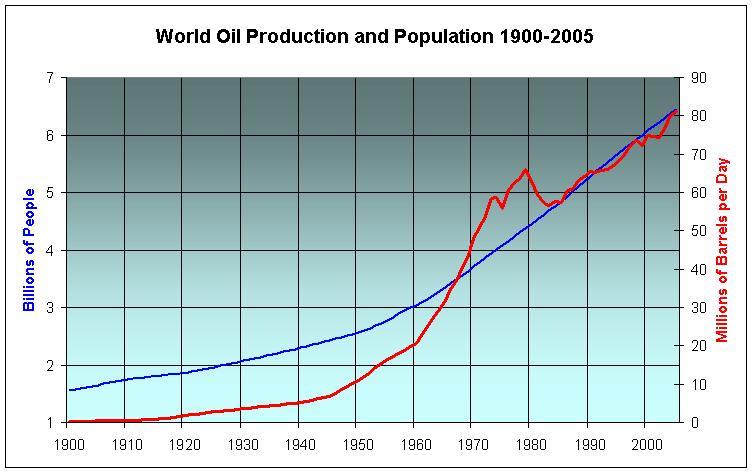
*In reality, the right half of the bell curve will probably be stretched out over more time than the left half due to supply, demand, rising prices and the end of economic growth.
**Although for much of those years, the relative low supply can be directly attributed to some politically motivated actions taken by the OPEC nations, where they purposely limited the global oil supply to manipulate prices.
***Imagine the pop bottle and rice example in reverse. Start adding twice as much rice to the bottle every minute for an hour. At 12:59 the bottle will be half empty. At 1:00 it will be full. At 1:01 you could fill two bottles, if you had another one. Currently, we only have one planet.
**Although for much of those years, the relative low supply can be directly attributed to some politically motivated actions taken by the OPEC nations, where they purposely limited the global oil supply to manipulate prices.
***Imagine the pop bottle and rice example in reverse. Start adding twice as much rice to the bottle every minute for an hour. At 12:59 the bottle will be half empty. At 1:00 it will be full. At 1:01 you could fill two bottles, if you had another one. Currently, we only have one planet.
Thursday, January 6, 2011
Getting What We Deserve
I had a whole thing written up where I made some predictions for the coming year but I figured I could do that in one (rather long) paragraph. Murphy's Law says that if something can go wrong it will go wrong. There are so many things that can go wrong in the next year that I think it's almost inevitable. The housing market is still a mess, and there is a huge inventory of homes that is only going to grow, putting more downward pressure on prices. States and cities have huge budget problems, mostly because of unrealistic and unfunded pension liabilities to public employee unions. They lack the ability to print money in order to avoid tough decisions, but the federal government will most likely take care of that for them somehow. The European debt crisis is only going to get worse in 2011, which will lead to more instability worldwide. The federal budget deficit of $1.3 trillion will not have significant changes, and unless the fed continues to buy bonds, interest rates will go up dramatically. Higher interest rates will expose a lot of problems everywhere. The fed has no plan to unload its balance sheet that has grown by many trillions of dollars in the past couple of years. There is an oncoming explosion of student loan defaults on the horizon, which could start to blow up in 2011. FDIC insolvency, big bank failures, skyrocketing energy and food prices, ad nauseum. And even in the absolute best possible scenario, unemployment will still be above 8.5% in one year. If any one of these problems occur in the way that I think is possible (catastrophe, not a minor problem), it'll domino throughout the whole economy and 2011 could be the year that it all hits the fan. But enough of that. In the end, we deserve to get it splattered all over us.
In the past few decades, Americans have come to have some unrealistic and conflicting expectations. Once the federal government started to provide for people, as opposed to creating a situation where people are capable of providing for themselves, the demand to be provided for has exploded.
We want everyone who gets a terminal disease to live another 30 years. We also want the government to keep our health care costs low. Somehow. Any way.
We cheer when government financial institutions guarantee loans so we can buy homes with no money down and low interest rates and then call on the government to help us out when we can no longer afford our homes. Somehow. Any way.
Nobody bats an eye when the federal government guarantees student loans that allow an 18-year-old to go $200,000 in debt so he or she can get a degree in Music Appreciation, Physical Education, or The Many Shades Of Concrete. And then we want the government to help us with our debt problems when we can't find a job that pays a sufficient salary to repay our loans. Somehow. Any way.
When credit card companies charge 20% interest, and suddenly that $500 PS3 is costing you $5,000, we cry to congress to pass a law to keep them from doing it instead of --gasp-- saving until we can afford that stuff. Then, when we have to get a payday loan at a pawn shop with even higher interest just to buy food or keep the lights on, we get pissed because credit isn't available and call on the government to help us out. Somehow. Any way.
We don't get upset when we spend trillions of dollars in order to fight never ending pseudo-wars, but get upset because we're trillions of dollars in debt and expect our government to fix the problem. Somehow. Any way.
We want the government to cure economic imbalances, but we want the medicine to taste good.
We twiddle our thumbs and grind our teeth while muttering "gosh, I don't like this but if they say we have to do it then I guess it's true" under our breath when the government props up a phony economy by giving trillions of dollars to corporations that made bad decisions and have no reason to exist anymore. Then after we give all that money to people who we recognize as corrupt and greedy scumbags, we act shocked and appalled when they use that bailout money to buy themselves an island or 2 in the pacific.
We want unemployment benefits, welfare for the poor, food stamps for half of us, wars in the middle east, low house prices when we buy, higher house prices sometime after that, medicare, medicaid, social security, cheap food, high wages, retirement at 60, low taxes, billions of gallons of oil, no oil spills, rules and regulations on oil companies when a spill happens, low oil prices, safe airplane travel, convenient airplane travel, some cake, our government to feed it to us too.
At some point we started to act like children, expecting the government to provide for us, no matter what the costs. Is it any wonder that we now have a government that treats us like children? Entitled brats with no motivation to expend any more energy than what is absolutely necessary to get by. We put as little effort into the system as possible, refusing to pick up a book and become educated on the issues, opting instead to trust those in charge (or worse yet, silently distrust them while sitting idly by) and let them do what they do. Less than half of us vote, which, by the way, is the lowest possible form of civic participation, and the vast majority of voters refuse to participate at any higher level. And then we complain when things go wrong, or more problems are created, or we find ourselves $14 trillion in debt with hundreds of trillions of dollars in unfunded liabilities.
The harsh reality is that we have a mountain of debt because we asked for a mountain of debt. We wanted to live like millionaires on a $40,000 salary and we have done just that for a few decades. Even those who are the most concerned about the debt problem don't want to have their programs cut. Get our spending in order, but don't take away my medicare or social security. Increase revenues to the government, but raise the other guy's taxes, not mine. Fix the problems, but don't make it painful.
Because we had this mindset for so long, we have reached a point where any meaningful solutions MUST be painful. Extremely painful. But I don't think Americans are ready to face the pain. We don't want to give up enough. We would much rather hear lip service from those in charge and believe the illusion that that is enough.
In the coming months we'll see some very telling and symbolic actions in congress. The 14.3 trillion dollar debt ceiling, set by congress, will be reached between March and May. Some congressmen are threatening to vote against raising the debt ceiling, essentially forcing congress to cut any spending beyond what we have in tax revenue. Cutting 1.3 trillion dollars a year in spending would force some very difficult decisions on congress. Austan Goolsbee, Obama's top economic adviser, said that failing to raise the debt ceiling would be the same as defaulting on our debt and would be catastrophic for the economy. In other words, if we don't go into more debt we can't pay off our current debt. In even other words, he admitted that we're running a gigantic ponzi scheme. Relying on new money to pay off the old money is the definition of a ponzi scheme.
He is right about everything, especially the catastrophic part. Getting on sound financial ground would mean a lot of pain to a lot of people. And because the people aren't willing to face that pain, congress will vote to raise the debt ceiling to protect its children from pain today and ensure that we'll face greater pain in the future. Of course, we'll still want lip service and empty promises to make it feel like something is being done. Many will vote to raise the debt ceiling under the condition that there are cuts in the budget. And we'll probably see spending cuts, but those cuts won't be able to cause too much pain to the people so they'll be extremely insignificant. We might see 50 or 70 billion dollars in cuts out of a 1.3 trillion dollar deficit. To put it simply, they'll put a band aid on a gunshot wound because surgery would be too painful. And it'll all be done because it's all we really want to bear.
People who study human behavior have found something interesting called the “discount rate”. The discount rate basically measures the sense of urgency with which people view problems and compare it to how far into the future those problems will occur. If you look at the chart you'll see that people are extremely short sighted. We tend to only react to problems that are happening or are on the brink of happening. Our sense of urgency decreases dramatically, to near zero, whenever something is not imminent. We see this behavior all the time. Even when we hear a week in advance about a snow storm that is coming, most everybody rushes to the grocery store the day of the storm or the day before if they're ambitious. We simply aren't good at looking beyond the here and now. Carpe diem. I guess it's foolish of me to believe that, as a group, we would behave any different with our national debt crisis. It would also be foolish to believe that we'll realize we need to make drastic changes before it's too late. It might be too late already.
In the past few decades, Americans have come to have some unrealistic and conflicting expectations. Once the federal government started to provide for people, as opposed to creating a situation where people are capable of providing for themselves, the demand to be provided for has exploded.
We want everyone who gets a terminal disease to live another 30 years. We also want the government to keep our health care costs low. Somehow. Any way.
We cheer when government financial institutions guarantee loans so we can buy homes with no money down and low interest rates and then call on the government to help us out when we can no longer afford our homes. Somehow. Any way.
Nobody bats an eye when the federal government guarantees student loans that allow an 18-year-old to go $200,000 in debt so he or she can get a degree in Music Appreciation, Physical Education, or The Many Shades Of Concrete. And then we want the government to help us with our debt problems when we can't find a job that pays a sufficient salary to repay our loans. Somehow. Any way.
When credit card companies charge 20% interest, and suddenly that $500 PS3 is costing you $5,000, we cry to congress to pass a law to keep them from doing it instead of --gasp-- saving until we can afford that stuff. Then, when we have to get a payday loan at a pawn shop with even higher interest just to buy food or keep the lights on, we get pissed because credit isn't available and call on the government to help us out. Somehow. Any way.
We don't get upset when we spend trillions of dollars in order to fight never ending pseudo-wars, but get upset because we're trillions of dollars in debt and expect our government to fix the problem. Somehow. Any way.
We want the government to cure economic imbalances, but we want the medicine to taste good.
We twiddle our thumbs and grind our teeth while muttering "gosh, I don't like this but if they say we have to do it then I guess it's true" under our breath when the government props up a phony economy by giving trillions of dollars to corporations that made bad decisions and have no reason to exist anymore. Then after we give all that money to people who we recognize as corrupt and greedy scumbags, we act shocked and appalled when they use that bailout money to buy themselves an island or 2 in the pacific.
We want unemployment benefits, welfare for the poor, food stamps for half of us, wars in the middle east, low house prices when we buy, higher house prices sometime after that, medicare, medicaid, social security, cheap food, high wages, retirement at 60, low taxes, billions of gallons of oil, no oil spills, rules and regulations on oil companies when a spill happens, low oil prices, safe airplane travel, convenient airplane travel, some cake, our government to feed it to us too.
At some point we started to act like children, expecting the government to provide for us, no matter what the costs. Is it any wonder that we now have a government that treats us like children? Entitled brats with no motivation to expend any more energy than what is absolutely necessary to get by. We put as little effort into the system as possible, refusing to pick up a book and become educated on the issues, opting instead to trust those in charge (or worse yet, silently distrust them while sitting idly by) and let them do what they do. Less than half of us vote, which, by the way, is the lowest possible form of civic participation, and the vast majority of voters refuse to participate at any higher level. And then we complain when things go wrong, or more problems are created, or we find ourselves $14 trillion in debt with hundreds of trillions of dollars in unfunded liabilities.
The harsh reality is that we have a mountain of debt because we asked for a mountain of debt. We wanted to live like millionaires on a $40,000 salary and we have done just that for a few decades. Even those who are the most concerned about the debt problem don't want to have their programs cut. Get our spending in order, but don't take away my medicare or social security. Increase revenues to the government, but raise the other guy's taxes, not mine. Fix the problems, but don't make it painful.
Because we had this mindset for so long, we have reached a point where any meaningful solutions MUST be painful. Extremely painful. But I don't think Americans are ready to face the pain. We don't want to give up enough. We would much rather hear lip service from those in charge and believe the illusion that that is enough.
In the coming months we'll see some very telling and symbolic actions in congress. The 14.3 trillion dollar debt ceiling, set by congress, will be reached between March and May. Some congressmen are threatening to vote against raising the debt ceiling, essentially forcing congress to cut any spending beyond what we have in tax revenue. Cutting 1.3 trillion dollars a year in spending would force some very difficult decisions on congress. Austan Goolsbee, Obama's top economic adviser, said that failing to raise the debt ceiling would be the same as defaulting on our debt and would be catastrophic for the economy. In other words, if we don't go into more debt we can't pay off our current debt. In even other words, he admitted that we're running a gigantic ponzi scheme. Relying on new money to pay off the old money is the definition of a ponzi scheme.
He is right about everything, especially the catastrophic part. Getting on sound financial ground would mean a lot of pain to a lot of people. And because the people aren't willing to face that pain, congress will vote to raise the debt ceiling to protect its children from pain today and ensure that we'll face greater pain in the future. Of course, we'll still want lip service and empty promises to make it feel like something is being done. Many will vote to raise the debt ceiling under the condition that there are cuts in the budget. And we'll probably see spending cuts, but those cuts won't be able to cause too much pain to the people so they'll be extremely insignificant. We might see 50 or 70 billion dollars in cuts out of a 1.3 trillion dollar deficit. To put it simply, they'll put a band aid on a gunshot wound because surgery would be too painful. And it'll all be done because it's all we really want to bear.
People who study human behavior have found something interesting called the “discount rate”. The discount rate basically measures the sense of urgency with which people view problems and compare it to how far into the future those problems will occur. If you look at the chart you'll see that people are extremely short sighted. We tend to only react to problems that are happening or are on the brink of happening. Our sense of urgency decreases dramatically, to near zero, whenever something is not imminent. We see this behavior all the time. Even when we hear a week in advance about a snow storm that is coming, most everybody rushes to the grocery store the day of the storm or the day before if they're ambitious. We simply aren't good at looking beyond the here and now. Carpe diem. I guess it's foolish of me to believe that, as a group, we would behave any different with our national debt crisis. It would also be foolish to believe that we'll realize we need to make drastic changes before it's too late. It might be too late already.
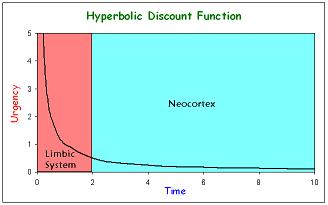
At some point our budget problems will fuel a currency crisis and congress will run out of ways to kick the can down the road. Thomas Jefferson said that we needed a revolution every generation to keep the population from becoming complacent, apathetic and removed from the political system. We're many generations overdue for a revolution. When the currency crisis starts, so will our revolution. Maybe it'll happen in 2011. Maybe we can hold off until 2012. I doubt we can delay the inevitable any longer than that, no matter how much we want to. And it'll all be because we pay for what we feel we are entitled to today with money we hope we have in 10 years. Worse than that, we stand in the face of this harsh reality and try to convince ourselves that we can keep the scheme working. Somehow. Any way. If that doesn't sound like the mindset of a people that deserves to get splattered with shit from a fan, I don't know what does.
Wednesday, December 15, 2010
Treasuries? More Like Trashuries!
I mentioned a couple months ago that I might want to talk about the bond bubble at some point. Well we recently started to see some news that the bond market could be collapsing so I decided to finally dive in. I've gotta admit, the whole process is a little tricky to understand and I'm not going to pretend to be an expert. Every time I do some research on the subject, it just leaves me with more questions than I started with, but I'll do my best anyway.
When the federal government runs a budget deficit, that budget has to get funded somehow. Well, since it's a budget deficit, that means the treasury doesn't have enough money from taxes to fund the budget. So what they do is sell "treasury securities" (also called "treasuries" or "securities". I'll use those terms interchangeably). An investor (bank, individual, foreign government, etc.) buys those treasuries, the treasury gets extra money and the budget gets funded. The securities are then paid back to the investor after a period of time, with interest of course.
These securities come in 3 forms. The first type of treasury securities are called T-bills. They are short term securities that generally mature in a year or less. Another type is called T-notes and they mature in 2-5 years. The last type of security is called T-bonds. They are the longest term and mature in up to 30 years.
Ok, that's basically all you need to know. At least it better be, because that's basically all I know.
As I mentioned before, the treasury department will sell these securities to fund budget deficits. Sometimes, the federal reserve (the fed) will announce that they want to buy some of these securities in order to increase the money supply. That is called quantitative easing and it's how the fed gets money into the system in order to stimulate it. But the fed cannot buy directly from the treasury. I think it's actually a law. So what the fed does is it tells certain banks that it deals with that they are going to buy up some securities. The banks wheel and deal and make bids to the fed and whoever has the lowest bid gets to sell the securities to the fed. Long story short, the banks buy treasuries from the treasury and then sells them to the fed, at a higher price of course.
Banks give cash to the treasury, the treasury can fund the debt, and then the federal reserve pays the banks. That's where it gets interesting. When the fed buys the securities from the bank, it does so with new money. Money that never existed before. Money that has nothing tangible backing it up. Fiat money. Money that's not worth the paper it's printed on. Actually, they don't even really print the money. They just add a few zeros to the bank's balance sheet. The money is all digitized, created out of thin air and added to a computer as 1's and 0's. I guess you could say it's money that isn't worth the paper that it's not printed on. Anyway, that's where all the inflation fear comes from. More money starts to chase the same number of goods and inflation is the result.
I mentioned that the different types of securities all have different rates of maturity. A lot of the debt that has been funded in the past year or so has been with the short term T-bills because the interest rate is so low. When those T-bills mature, then the treasury has to pay back the principle and interest. But remember, that money was used for funding the government. When those T-bills come back, the treasury will still have to sell many of those same bills again, plus a lot more to service the new debt on the new budget deficit that congress passed in the meantime. It's as if you max out your credit card but can't afford to pay it off at the end of the month and your solution is to get 2 more credit cards. One to pay off your first card and another one to buy more stuff you can't afford. Actually, you are doing that because it's your money that they're spending. Neat, huh?
When the global financial crisis hit, a lot of people rushed to buy treasury securities. The conventional wisdom is that when everything else is doing poorly, the safest place to have your money is in American guaranteed dollars. I guess old habits die hard. With so many people wanting to buy bonds and bills and notes from the treasury, the treasury didn't have to offer a whole lot of interest to the buyer. The interest rate on the 30 year bond went down to about 3.5%. That's extremely low. It also means that it's extremely cheep for the treasury to service the federal debt. That means that congress is more likely to have budget deficits and issue more debt. That cycle continues, and it can only exist with plenty of people willing to buy treasuries and low interest rates.
But what happens if people start to get the mindset that the only thing worse than owning the dollar today is to own a promise to be paid in dollars 30 years from now? People, banks and foreign governments can sell those bonds on the open market. If you're worried about inflation, you would probably want to sell your $100 treasury bond for $80. That way you get today's dollars and not an inflated, worthless dollar in 30 years. Then it becomes more difficult for the treasury to sell new bonds unless they raise the interest rate. Would you buy a $100 bond from the treasury when you can get it from someone else for $80? Not unless the treasury was going to offer a much higher interest rate on the new bond.
But as I said before, all of these budget deficits were only possible because the treasury could find buyers of their securities and the interest rates were so low. When interest rates rise, then the treasury goes into more debt and does so faster because it's paying more interest to service that debt. And without new money coming in, either in the form of a budget surplus (feel free to laugh at that) or new bond buyers, it becomes impossible to fund government. Unless of course congress stops funding government services beyond what it can afford (feel free to laugh at that) or the fed comes to the rescue and buys up those securities in exchange for a few extra digits on a bank's balance sheet punched into a computer that represents money. And it seems extremely likely that the fed will do just that. If you're expecting this new congress to cut spending in any significant way, well, let's just say I wouldn't hold my breath.
Why would the fed do this if it will cause high inflation? First, they claim that injecting new money into the system will cause job creation. Second, it's possible that the treasury is having a tough time finding buyers for their treasuries. That would mean that the treasury has to pay much higher interest on our debt. We currently pay about a half a trillion dollars on interest alone. If rates rise even moderately, we could easily be paying over a trillion dollars a year on interest, not to mention the principle.
Why would congress continue to issue more debt? Because the alternative is to take government services away from people. Trust me, if they started to do that, there would be a lot of angry people. Once the government starts to provide a service to people, the people become dependent on that service and feel like it is essential to their lives. Then it's nearly impossible to make cuts to those services without political backlash. Hell, even the tea party people are against cuts to medicare and social security, which are by far two of the largest contributors to the deficit.
Without any other buyers of treasury securities, and without major spending cuts, the only thing we can do to keep the gravy train rolling, at least for a while, is to have the fed buy treasury securities and wait for the inflation to steal any wealth we may have.
One main reason we can have such low interest rates is because Moody's gives us a AAA rating. They recently said that could change if budget deficits continue to increase.
There are some early signs that investors are selling off their treasury securities. Last week saw the largest 2 day sell off since the collapse of Lehman Brothers in 2008.
The interest rate on the 10 year treasury note recently reached a 6 month high, and most economists expect the trend to continue.
Last November gave us a budget deficit of $150.4 billion. That's the largest November budget deficit in history.
It's not just the new tax deal without spending cuts that has the world spooked about our economy. The truth is that the world reacted very negatively when the fed announced a new round of quantitative easing back in November.
The American public is also losing faith in the effectiveness of the fed.
Investors all around the world are starting to realize that there is no way American can ever pay back its debt. David Bloom, currency chief at HCBS, recently said "If yields are rising because people think America's fiscal situation is unsustainable, then its Armaggedon." There is also growing concern among investors that the federal reserve simply doesn't care about the dangers of inflation. This is making owners of treasuries very nervous. Stephen Lewis of Monument Securities also said "There is a feeling that the fed doesn't care about inflation, in fact wants more of it, and that is certainly not in the interest of bondholders"
Over the next 12 months, the U.S. government is going to be rolling over trillions of dollars in debt (the treasury securities will be maturing) along with all of the new borrowing that it is going to be doing. In fact, the U.S. government is somehow going to have to find a way to finance debt that is 27.8% of GDP in 2011.
For decades our leaders have told us that "deficits don't matter". What we're all going to find out is - spoiler alert - our politicians have been lying to us. The sad part is that most people still don't understand the magnitude of our debt problems. As the federal government's total debt approaches 14 trillion dollars, that only represents a small fraction of the real problem. The government has reached a "fiscal gap" of 202 trillion dollars. That "real debt" includes our current federal debt plus all the other unfunded liabilities that the government has made commitments to pay but has no actual plan or ability to pay. Just to put it in perspective, if the government taxed 100% of everyone's money in the country, it would have to do so for nearly 13.5 years to pay off that "real debt". Does anyone actually think we'll ever pay that money back?
Let me try to recap the federal government's actions into a very simple statement. Our national debt needs a continual source of new treasuries buyers in order to pay off the old buyers of treasuries once they mature. Without a new supply of buyers, we can't pay the people we promised money to.
What I just described there is the textbook definition of a Ponzi scheme. They are exactly the same. Tweak a few words and those two sentences could also read like this: Bernie Madoff needed a continual source of new investors in order to pay off the old investors once they retired. Without a new supply of investors, he couldn't pay the people he promised money to.... and anyone who was financially invested in him lost everything they had.
As a citizen and a taxpayer, we're all financially invested in the federal government. And thanks to our government, the entire economy is one gigantic Ponzi scheme.
When the federal government runs a budget deficit, that budget has to get funded somehow. Well, since it's a budget deficit, that means the treasury doesn't have enough money from taxes to fund the budget. So what they do is sell "treasury securities" (also called "treasuries" or "securities". I'll use those terms interchangeably). An investor (bank, individual, foreign government, etc.) buys those treasuries, the treasury gets extra money and the budget gets funded. The securities are then paid back to the investor after a period of time, with interest of course.
These securities come in 3 forms. The first type of treasury securities are called T-bills. They are short term securities that generally mature in a year or less. Another type is called T-notes and they mature in 2-5 years. The last type of security is called T-bonds. They are the longest term and mature in up to 30 years.
Ok, that's basically all you need to know. At least it better be, because that's basically all I know.
As I mentioned before, the treasury department will sell these securities to fund budget deficits. Sometimes, the federal reserve (the fed) will announce that they want to buy some of these securities in order to increase the money supply. That is called quantitative easing and it's how the fed gets money into the system in order to stimulate it. But the fed cannot buy directly from the treasury. I think it's actually a law. So what the fed does is it tells certain banks that it deals with that they are going to buy up some securities. The banks wheel and deal and make bids to the fed and whoever has the lowest bid gets to sell the securities to the fed. Long story short, the banks buy treasuries from the treasury and then sells them to the fed, at a higher price of course.
Banks give cash to the treasury, the treasury can fund the debt, and then the federal reserve pays the banks. That's where it gets interesting. When the fed buys the securities from the bank, it does so with new money. Money that never existed before. Money that has nothing tangible backing it up. Fiat money. Money that's not worth the paper it's printed on. Actually, they don't even really print the money. They just add a few zeros to the bank's balance sheet. The money is all digitized, created out of thin air and added to a computer as 1's and 0's. I guess you could say it's money that isn't worth the paper that it's not printed on. Anyway, that's where all the inflation fear comes from. More money starts to chase the same number of goods and inflation is the result.
I mentioned that the different types of securities all have different rates of maturity. A lot of the debt that has been funded in the past year or so has been with the short term T-bills because the interest rate is so low. When those T-bills mature, then the treasury has to pay back the principle and interest. But remember, that money was used for funding the government. When those T-bills come back, the treasury will still have to sell many of those same bills again, plus a lot more to service the new debt on the new budget deficit that congress passed in the meantime. It's as if you max out your credit card but can't afford to pay it off at the end of the month and your solution is to get 2 more credit cards. One to pay off your first card and another one to buy more stuff you can't afford. Actually, you are doing that because it's your money that they're spending. Neat, huh?
When the global financial crisis hit, a lot of people rushed to buy treasury securities. The conventional wisdom is that when everything else is doing poorly, the safest place to have your money is in American guaranteed dollars. I guess old habits die hard. With so many people wanting to buy bonds and bills and notes from the treasury, the treasury didn't have to offer a whole lot of interest to the buyer. The interest rate on the 30 year bond went down to about 3.5%. That's extremely low. It also means that it's extremely cheep for the treasury to service the federal debt. That means that congress is more likely to have budget deficits and issue more debt. That cycle continues, and it can only exist with plenty of people willing to buy treasuries and low interest rates.
But what happens if people start to get the mindset that the only thing worse than owning the dollar today is to own a promise to be paid in dollars 30 years from now? People, banks and foreign governments can sell those bonds on the open market. If you're worried about inflation, you would probably want to sell your $100 treasury bond for $80. That way you get today's dollars and not an inflated, worthless dollar in 30 years. Then it becomes more difficult for the treasury to sell new bonds unless they raise the interest rate. Would you buy a $100 bond from the treasury when you can get it from someone else for $80? Not unless the treasury was going to offer a much higher interest rate on the new bond.
But as I said before, all of these budget deficits were only possible because the treasury could find buyers of their securities and the interest rates were so low. When interest rates rise, then the treasury goes into more debt and does so faster because it's paying more interest to service that debt. And without new money coming in, either in the form of a budget surplus (feel free to laugh at that) or new bond buyers, it becomes impossible to fund government. Unless of course congress stops funding government services beyond what it can afford (feel free to laugh at that) or the fed comes to the rescue and buys up those securities in exchange for a few extra digits on a bank's balance sheet punched into a computer that represents money. And it seems extremely likely that the fed will do just that. If you're expecting this new congress to cut spending in any significant way, well, let's just say I wouldn't hold my breath.
Why would the fed do this if it will cause high inflation? First, they claim that injecting new money into the system will cause job creation. Second, it's possible that the treasury is having a tough time finding buyers for their treasuries. That would mean that the treasury has to pay much higher interest on our debt. We currently pay about a half a trillion dollars on interest alone. If rates rise even moderately, we could easily be paying over a trillion dollars a year on interest, not to mention the principle.
Why would congress continue to issue more debt? Because the alternative is to take government services away from people. Trust me, if they started to do that, there would be a lot of angry people. Once the government starts to provide a service to people, the people become dependent on that service and feel like it is essential to their lives. Then it's nearly impossible to make cuts to those services without political backlash. Hell, even the tea party people are against cuts to medicare and social security, which are by far two of the largest contributors to the deficit.
Without any other buyers of treasury securities, and without major spending cuts, the only thing we can do to keep the gravy train rolling, at least for a while, is to have the fed buy treasury securities and wait for the inflation to steal any wealth we may have.
SIGNS THE PARTY IS ALMOST OVER:
There are some early signs that investors are selling off their treasury securities. Last week saw the largest 2 day sell off since the collapse of Lehman Brothers in 2008.
The interest rate on the 10 year treasury note recently reached a 6 month high, and most economists expect the trend to continue.
Last November gave us a budget deficit of $150.4 billion. That's the largest November budget deficit in history.
It's not just the new tax deal without spending cuts that has the world spooked about our economy. The truth is that the world reacted very negatively when the fed announced a new round of quantitative easing back in November.
The American public is also losing faith in the effectiveness of the fed.
Investors all around the world are starting to realize that there is no way American can ever pay back its debt. David Bloom, currency chief at HCBS, recently said "If yields are rising because people think America's fiscal situation is unsustainable, then its Armaggedon." There is also growing concern among investors that the federal reserve simply doesn't care about the dangers of inflation. This is making owners of treasuries very nervous. Stephen Lewis of Monument Securities also said "There is a feeling that the fed doesn't care about inflation, in fact wants more of it, and that is certainly not in the interest of bondholders"
Over the next 12 months, the U.S. government is going to be rolling over trillions of dollars in debt (the treasury securities will be maturing) along with all of the new borrowing that it is going to be doing. In fact, the U.S. government is somehow going to have to find a way to finance debt that is 27.8% of GDP in 2011.
For decades our leaders have told us that "deficits don't matter". What we're all going to find out is - spoiler alert - our politicians have been lying to us. The sad part is that most people still don't understand the magnitude of our debt problems. As the federal government's total debt approaches 14 trillion dollars, that only represents a small fraction of the real problem. The government has reached a "fiscal gap" of 202 trillion dollars. That "real debt" includes our current federal debt plus all the other unfunded liabilities that the government has made commitments to pay but has no actual plan or ability to pay. Just to put it in perspective, if the government taxed 100% of everyone's money in the country, it would have to do so for nearly 13.5 years to pay off that "real debt". Does anyone actually think we'll ever pay that money back?
Let me try to recap the federal government's actions into a very simple statement. Our national debt needs a continual source of new treasuries buyers in order to pay off the old buyers of treasuries once they mature. Without a new supply of buyers, we can't pay the people we promised money to.
What I just described there is the textbook definition of a Ponzi scheme. They are exactly the same. Tweak a few words and those two sentences could also read like this: Bernie Madoff needed a continual source of new investors in order to pay off the old investors once they retired. Without a new supply of investors, he couldn't pay the people he promised money to.... and anyone who was financially invested in him lost everything they had.
As a citizen and a taxpayer, we're all financially invested in the federal government. And thanks to our government, the entire economy is one gigantic Ponzi scheme.
Wednesday, November 17, 2010
Obama is the perfect president, so don't let him do much.
My reach is global-Flobots
My tower secure
My cause is noble
My power is pure
I can hand out a million vaccinations
Or let them all die from exasperation
Have them all healed from their lacerations
Or have them all killed by assassination
I try to avoid discussing President Obama for a few reasons, mostly because the conversation usually misses the point. On TV you'll see lunatics on the right who claim that he's purposefully trying to destroy the country so he and the lefties can rebuild it in their image. You'll also see lunatics on the left claim that he's the smartest and greatest person to ever hold elected office and we need to let him do whatever he can to fix the terrible mess he inherited. He understands the issues better than anyone and, given that, he should have carte blanche to do whatever is necessary to fix the problems. This post will mostly address the people who support Obama and his policies, and I'll attempt to explain why even his strongest supporters shouldn't support many of his decisions, even if they're the right ones.
For the sake of argument, I'm going to have to make a few assumptions, many of which aren't even too far off from how I really feel about the guy. Since I'm addressing the Obama supporters, I'll have the assumptions cater to their arguments and views, and take them to the extreme to make my point. Let's assume that he is the smartest person in any room he enters. Let's assume that he has a greater understanding of the issues than anyone else and he is 100% right on everything. Let's assume that he has the country's best interest in mind and will not ever be corrupted in any way. And let's even go so far as to assume that every decision that he makes is perfect in every way and ushers in a new, unprecedented era of prosperity for not only the country but every single individual. Everything he does and every law he passes is perfect, great and pure in every way. The Health Care Law is the perfect law to fix the problems in the industry. The war in Afghanistan is being waged in the perfect way, killing only those people we want to kill without harming innocent civilians or disrupting their society in any negative way. The trillions spent on stimulus and bailouts work exactly the way they should and we see economic growth like we've never seen before, leaving nobody behind and benefiting all. Essentially he is a perfect, magnanimous, benevolent and wise leader, like Bill Pullman in Independence Day, only better. Let's start from there.
So what should we do, given the assumptions that I laid out above? The easy answer would be to step back and let him work his magic. Let him make the tough decisions and give him whatever he needs in order to follow through with them. Whatever changes he wants to make to health care, we should support him. Any amount of money he wants to spend to improve the economy, we should support him. After all, any decision he makes is going to have amazing results and we won't have to give up any freedoms to accomplish them. What would be the result of this course of action? Well, given the assumptions that I made, we would certainly find ourselves living in a Utopian society in a very short period of time, and supporting Obama in all of his endeavors would certainly lead to great and amazing results.
There's only one problem with doing that though. At some point President Obama will leave office. Even if he is so wonderful that we let him be our president for life and an entire generation grows up in a perfect society with a perfect leader, at some point he will die.* And when he is no longer the president, we will have to elect a new one. That new president will suddenly have all the power and authority that we gave to Obama, and the chances are pretty good that the new president won't be able to manage all that power in such a great way.
You see, the power of the Presidency sticks around much longer than any one president, so when we give any power to an elected official, we're also giving that power to everyone else who holds the office in the future. This is something we all know, but tend to forget when it's "our guy" in charge. When we gave President Bush the power to wire tap our phones to keep us safe, we also gave that power to future presidents who might not use the power so sparingly. When we gave President Obama the power to overhaul the health care industry to keep us healthy, we also gave that power to future presidents, some of whom might not have our best health in mind. When we gave Obama the power to spend trillions of our dollars to stimulate the economy and bailout corporations, even if it was the perfect solution to a terrible problem and everything works out wonderfully, we gave that same power to everyone else that comes after him. And there's a chance that the next guy won't use that power and spend that money in such a perfect way.
If you're reading this and trying to either defend or indict his policies that I meantioned, then you're missing the point. This has nothing to do with Obama or his policies. It has everything to do with the power he has. Even if his policies are the perfect policies, we still shouldn't support him if those policies allow the president to have any power over the individual citizens. If you love the man and think his policies are great, that's awesome and I'm glad you got the perfect president. Just remember that the next guy probably won't be as perfect and you might wish the president didn't have so much power. If you don't agree with what he's done and want to "take back Washington", remember this. Because eventually your guy will get into office and he'll probably use the power to shuffle trillions of dollars, but in the way he wants to, and fight wars without approval from congress, but the ones that he wants to fight. And it'll all be done because at some point we gave someone else the power to do that because we liked the way he used the power.
Just because someone is using their power in a way that you agree with doesn't mean the person should have that power. In fact, it's even more important to deny a president more power when we approve of his policies because it's very likely that we won't object to a whole lot and we'll allow him a lot more power. Hopefully all the people who support Obama think of this when discussing how good of a job he did at overhauling the health care industry, or stimulating the economy, or fighting pseudo-wars, or fixing the car industry, or stabilizing the housing market, or anything else that he did or does. We shouldn't be asking if these policies are going to deliver good or bad results, we should be asking if we want to give so much power to a small number of people. Because even if everything works out and the country is better because of these policies, it's still dangerous to give the president enough power to overhaul huge industries, distribute trillions of borrowed dollars however he sees fit, wage war without approval from congress and influence the price of homes. Once we give that power away, it's nearly impossible to get it back and one day we might wake up and realize that we gave too much power to too few people.
I used the word "power" about 13,000 times and I just wanted to make the point that when someone has the ability to enact sweeping policy changes that are good, they also have the ability to enact sweeping policy changes that are bad. And the best defense against this catch 22 is to not give our leaders that ability in the first place. Keep the government as small as possible and leave the power with the millions of individual citizens, not whoever gets elected to office. If we don't follow that one simple rule, one day we might have a president with so much power that he resembles Old Spice Odor Blocker Body Wash. Then again, maybe that wouldn't be so bad either.
*I better clarify for the CIA, FBI, Secret Service and/or Fargo Police that might end up reading this. I only mean to imply that he is a mortal human and because of that he will die at some point. In no way should this line of reasoning be interpreted as a threat against President Obama or a suggestion to a lunatic.**
**Are there any lawyers out there who can let me know if I'm covering my bases here? I don't want to go to jail over this. And yes, I'm putting a footnote in a footnote. Why would I do such a thing? Because I can! I've gone mad with power!
Monday, October 25, 2010
How We Measure Inflation
I've been talking a lot about inflation lately. But if you look at the traditional way we measure inflation, the Consumer Price Index (CPI), we are seeing inflation of 1.1% which isn't very much at all. But like every number and statistic that you hear, you'll learn far more by looking at the methodology that was used to get that number or statistic.
Ostensibly, the CPI is a measure of consumer prices. That is, an imaginary shopping cart full of goods from many different sectors of the economy (food, houses, cars, clothing, energy, etc.) is brought to the checkout and the price of all those goods is added up. Then, one month later, the same imaginary shopping cart full of the same goods is brought to the checkout and the price is added again. By doing some simple math you can figure out what the rate of inflation or deflation is by comparing the change in the price of your shopping cart's contents. That seems like a very accurate and reasonable way to measure inflation, right? I think it does.And that's how the CPI is currently measured. That's how the CPI was measured before the 1980's. You see, modern economists and politicians have found some neat new ways to measure the price of those good in the shopping cart. Let's take a look, shall we?
Alan Greenspan and Michael Boskin argued that changes to the CPI needed to be made for certain items when they became too expensive. For instance, if the price of steak rose too high they should quit using steak in the CPI measurements and use hamburger instead. They reasoned that once steak got to a certain price, the consumer would simply eat hamburger instead. BAM! Now inflation isn't as high. Of course, this only shows the rate of inflation measured in terms of maintaining a lower standard of living. Inflation stayed low on paper but in real life inflation was higher and living standards decreased.
Some years later there was another change that took place. In addition to substituting cheaper goods for more expensive goods, the CPI started to use geometric weighting. This means that when the month-to-month (or year-to-year) prices are calculated, more weight is given to prices that are falling, and less weight is given to prices that are rising. If the price of bread has gone up 10% in the past month, but the price of milk has gone down 10%, then the official CPI measurement will give more weight to milk prices than bread prices, making the rate of inflation appear to be lower than it otherwise would.
More recently, the politicians and economists in charge have come up with a truly amazing new way to measure the CPI. It's called hedonics, and it shows that these guys will stop at nothing to make inflation appear to be lower than it actually is. Hedonics adjusts the price of goods for the increased pleasure the consumer derives from them. That 20% increase in the price of your washing machine? Well, that isn't going to be included in the CPI because of all the pleasure you get from pushing the fancy electronic buttons instead of turning the loud clicking wheel thing. When the price of gas goes up due to federally mandated additives, it doesn't raise the inflation rate because the consumer got so much thrill from breathing the fresh air.
I've read that the real inflation rate (measuring CPI with the methods that were in place before all these changes) could be up to 7 or 8% higher than what the official measurements are. And the Federal Reserve is making decisions based on a 1.1% inflation rate that they want to raise to about 2%. But because they use such innovative ways to measure inflation, the real inflation rate will have to go up a lot more than 1% in order to get the official number to go up 1%. I probably sound like a broken record but to me these are all signs that we're heading for an extremely high(er) rate of inflation.
If you're reading this you have access to the internet. If you're curious about any of this just use the internet to watch the dollar index and commodity prices to see what inflation is doing. The value of the dollar has been going down for some time and the price of sugar, cotton, corn, etc. has been going up. When commodity prices (food) go up, and the value of the dollar goes down, you're seeing inflation. The changes that I've been seeing in these two areas in recent months are significant.
The other day I was talking with someone about what I've been writing and I was told that I'm painting a really bleak picture. I couldn't argue with that, but I had to clarify that what I'm describing is still the worst case scenario. But with every passing day, and with every decision the Fed makes, the worst case scenario is looking more and more like the most likely scenario.
Pssst, that's not good.
Ostensibly, the CPI is a measure of consumer prices. That is, an imaginary shopping cart full of goods from many different sectors of the economy (food, houses, cars, clothing, energy, etc.) is brought to the checkout and the price of all those goods is added up. Then, one month later, the same imaginary shopping cart full of the same goods is brought to the checkout and the price is added again. By doing some simple math you can figure out what the rate of inflation or deflation is by comparing the change in the price of your shopping cart's contents. That seems like a very accurate and reasonable way to measure inflation, right? I think it does.
Alan Greenspan and Michael Boskin argued that changes to the CPI needed to be made for certain items when they became too expensive. For instance, if the price of steak rose too high they should quit using steak in the CPI measurements and use hamburger instead. They reasoned that once steak got to a certain price, the consumer would simply eat hamburger instead. BAM! Now inflation isn't as high. Of course, this only shows the rate of inflation measured in terms of maintaining a lower standard of living. Inflation stayed low on paper but in real life inflation was higher and living standards decreased.
Some years later there was another change that took place. In addition to substituting cheaper goods for more expensive goods, the CPI started to use geometric weighting. This means that when the month-to-month (or year-to-year) prices are calculated, more weight is given to prices that are falling, and less weight is given to prices that are rising. If the price of bread has gone up 10% in the past month, but the price of milk has gone down 10%, then the official CPI measurement will give more weight to milk prices than bread prices, making the rate of inflation appear to be lower than it otherwise would.
More recently, the politicians and economists in charge have come up with a truly amazing new way to measure the CPI. It's called hedonics, and it shows that these guys will stop at nothing to make inflation appear to be lower than it actually is. Hedonics adjusts the price of goods for the increased pleasure the consumer derives from them. That 20% increase in the price of your washing machine? Well, that isn't going to be included in the CPI because of all the pleasure you get from pushing the fancy electronic buttons instead of turning the loud clicking wheel thing. When the price of gas goes up due to federally mandated additives, it doesn't raise the inflation rate because the consumer got so much thrill from breathing the fresh air.
I've read that the real inflation rate (measuring CPI with the methods that were in place before all these changes) could be up to 7 or 8% higher than what the official measurements are. And the Federal Reserve is making decisions based on a 1.1% inflation rate that they want to raise to about 2%. But because they use such innovative ways to measure inflation, the real inflation rate will have to go up a lot more than 1% in order to get the official number to go up 1%. I probably sound like a broken record but to me these are all signs that we're heading for an extremely high(er) rate of inflation.
If you're reading this you have access to the internet. If you're curious about any of this just use the internet to watch the dollar index and commodity prices to see what inflation is doing. The value of the dollar has been going down for some time and the price of sugar, cotton, corn, etc. has been going up. When commodity prices (food) go up, and the value of the dollar goes down, you're seeing inflation. The changes that I've been seeing in these two areas in recent months are significant.
The other day I was talking with someone about what I've been writing and I was told that I'm painting a really bleak picture. I couldn't argue with that, but I had to clarify that what I'm describing is still the worst case scenario. But with every passing day, and with every decision the Fed makes, the worst case scenario is looking more and more like the most likely scenario.
Pssst, that's not good.
Subscribe to:
Posts (Atom)