Thursday, January 6, 2011

Getting What We Deserve

I had a whole thing written up where I made some predictions for the coming year but I figured I could do that in one (rather long) paragraph.  Murphy's Law says that if something can go wrong it will go wrong.  There are so many things that can go wrong in the next year that I think it's almost inevitable.  The housing market is still a mess, and there is a huge inventory of homes that is only going to grow, putting more downward pressure on prices.  States and cities have huge budget problems, mostly because of unrealistic and unfunded pension liabilities to public employee unions.  They lack the ability to print money in order to avoid tough decisions, but the federal government will most likely take care of that for them somehow.  The European debt crisis is only going to get worse in 2011, which will lead to more instability worldwide.  The federal budget deficit of $1.3 trillion will not have significant changes, and unless the fed continues to buy bonds, interest rates will go up dramatically.  Higher interest rates will expose a lot of problems everywhere.  The fed has no plan to unload its balance sheet that has grown by many trillions of dollars in the past couple of years.  There is an oncoming explosion of student loan defaults on the horizon, which could start to blow up in 2011.   FDIC insolvency, big bank failures, skyrocketing energy and food prices, ad nauseum.  And even in the absolute best possible scenario, unemployment will still be above 8.5% in one year.  If any one of these problems occur in the way that I think is possible (catastrophe, not a minor problem), it'll domino throughout the whole economy and 2011 could be the year that it all hits the fan.  But enough of that.  In the end, we deserve to get it splattered all over us.

In the past few decades, Americans have come to have some unrealistic and conflicting expectations.  Once the federal government started to provide for people, as opposed to creating a situation where people are capable of providing for themselves, the demand to be provided for has exploded.

We want everyone who gets a terminal disease to live another 30 years.  We also want the government to keep our health care costs low.  Somehow.  Any way.

We cheer when government financial institutions guarantee loans so we can buy homes with no money down and low interest rates and then call on the government to help us out when we can no longer afford our homes.  Somehow.  Any way.

Nobody bats an eye when the federal government guarantees student loans that allow an 18-year-old to go $200,000 in debt so he or she can get a degree in Music Appreciation, Physical Education, or The Many Shades Of Concrete.  And then we want the government to help us with our debt problems when we can't find a job that pays a sufficient salary to repay our loans.  Somehow.  Any way.

When credit card companies charge 20% interest, and suddenly that $500 PS3 is costing you $5,000, we cry to congress to pass a law to keep them from doing it instead of --gasp-- saving until we can afford that stuff.  Then, when we have to get a payday loan at a pawn shop with even higher interest just to buy food or keep the lights on, we get pissed because credit isn't available and call on the government to help us out.  Somehow.  Any way.

We don't get upset when we spend trillions of dollars in order to fight never ending pseudo-wars, but get upset because we're trillions of dollars in debt and expect our government to fix the problem.  Somehow.  Any way.

We want the government to cure economic imbalances, but we want the medicine to taste good.

We twiddle our thumbs and grind our teeth while muttering "gosh, I don't like this but if they say we have to do it then I guess it's true" under our breath when the government props up a phony economy by giving trillions of dollars to corporations that made bad decisions and have no reason to exist anymore.  Then after we give all that money to people who we recognize as corrupt and greedy scumbags, we act shocked and appalled when they use that bailout money to buy themselves an island or 2 in the pacific.

We want unemployment benefits, welfare for the poor, food stamps for half of us, wars in the middle east, low house prices when we buy, higher house prices sometime after that, medicare, medicaid, social security, cheap food, high wages, retirement at 60, low taxes, billions of gallons of oil, no oil spills, rules and regulations on oil companies when a spill happens, low oil prices, safe airplane travel, convenient airplane travel, some cake, our government to feed it to us too.

At some point we started to act like children, expecting the government to provide for us, no matter what the costs.  Is it any wonder that we now have a government that treats us like children?  Entitled brats with no motivation to expend any more energy than what is absolutely necessary to get by.  We put as little effort into the system as possible, refusing to pick up a book and become educated on the issues, opting instead to trust those in charge (or worse yet, silently distrust them while sitting idly by) and let them do what they do.  Less than half of us vote, which, by the way, is the lowest possible form of civic participation, and the vast majority of voters refuse to participate at any higher level.  And then we complain when things go wrong, or more problems are created, or we find ourselves $14 trillion in debt with hundreds of trillions of dollars in unfunded liabilities.

The harsh reality is that we have a mountain of debt because we asked for a mountain of debt.  We wanted to live like millionaires on a $40,000 salary and we have done just that for a few decades.  Even those who are the most concerned about the debt problem don't want to have their programs cut.  Get our spending in order, but don't take away my medicare or social security.  Increase revenues to the government, but raise the other guy's taxes, not mine.  Fix the problems, but don't make it painful.

Because we had this mindset for so long, we have reached a point where any meaningful solutions MUST be painful.  Extremely painful.  But I don't think Americans are ready to face the pain.  We don't want to give up enough.  We would much rather hear lip service from those in charge and believe the illusion that that is enough.

In the coming months we'll see some very telling and symbolic actions in congress.  The 14.3 trillion dollar debt ceiling, set by congress, will be reached between March and May.  Some congressmen are threatening to vote against raising the debt ceiling, essentially forcing congress to cut any spending beyond what we have in tax revenue.  Cutting 1.3 trillion dollars a year in spending would force some very difficult decisions on congress.  Austan Goolsbee, Obama's top economic adviser, said that failing to raise the debt ceiling would be the same as defaulting on our debt and would be catastrophic for the economy.  In other words, if we don't go into more debt we can't pay off our current debt.  In even other words, he admitted that we're running a gigantic ponzi scheme.  Relying on new money to pay off the old money is the definition of a ponzi scheme.

He is right about everything, especially the catastrophic part.  Getting on sound financial ground would mean a lot of pain to a lot of people.  And because the people aren't willing to face that pain, congress will vote to raise the debt ceiling to protect its children from pain today and ensure that we'll face greater pain in the future.  Of course, we'll still want lip service and empty promises to make it feel like something is being done.  Many will vote to raise the debt ceiling under the condition that there are cuts in the budget.  And we'll probably see spending cuts, but those cuts won't be able to cause too much pain to the people so they'll be extremely insignificant.  We might see 50 or 70 billion dollars in cuts out of a 1.3 trillion dollar deficit.  To put it simply, they'll put a band aid on a gunshot wound because surgery would be too painful.  And it'll all be done because it's all we really want to bear.

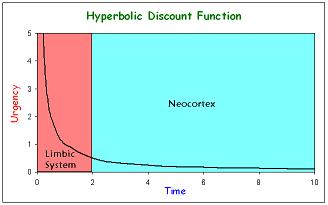
People who study human behavior have found something interesting called the “discount rate”. The discount rate basically measures the sense of urgency with which people view problems and compare it to how far into the future those problems will occur. If you look at the chart you'll see that people are extremely short sighted. We tend to only react to problems that are happening or are on the brink of happening. Our sense of urgency decreases dramatically, to near zero, whenever something is not imminent.  We see this behavior all the time. Even when we hear a week in advance about a snow storm that is coming, most everybody rushes to the grocery store the day of the storm or the day before if they're ambitious. We simply aren't good at looking beyond the here and now. Carpe diem. I guess it's foolish of me to believe that, as a group, we would behave any different with our national debt crisis.  It would also be foolish to believe that we'll realize we need to make drastic changes before it's too late.  It might be too late already.

At some point our budget problems will fuel a currency crisis and congress will run out of ways to kick the can down the road.  Thomas Jefferson said that we needed a revolution every generation to keep the population from becoming complacent, apathetic and removed from the political system.  We're many generations overdue for a revolution.  When the currency crisis starts, so will our revolution.  Maybe it'll happen in 2011.  Maybe we can hold off until 2012.  I doubt we can delay the inevitable any longer than that, no matter how much we want to.  And it'll all be because we pay for what we feel we are entitled to today with money we hope we have in 10 years.  Worse than that, we stand in the face of this harsh reality and try to convince ourselves that we can keep the scheme working.  Somehow.  Any way.  If that doesn't sound like the mindset of a people that deserves to get splattered with shit from a fan, I don't know what does.

Wednesday, December 15, 2010

Treasuries? More Like Trashuries!

I mentioned a couple months ago that I might want to talk about the bond bubble at some point.  Well we recently started to see some news that the bond market could be collapsing so I decided to finally dive in.  I've gotta admit, the whole process is a little tricky to understand and I'm not going to pretend to be an expert.  Every time I do some research on the subject, it just leaves me with more questions than I started with, but I'll do my best anyway. 

When the federal government runs a budget deficit, that budget has to get funded somehow.  Well, since it's a budget deficit, that means the treasury doesn't have enough money from taxes to fund the budget.  So what they do is sell "treasury securities" (also called "treasuries" or "securities".  I'll use those terms interchangeably).  An investor (bank, individual, foreign government, etc.) buys those treasuries, the treasury gets extra money and the budget gets funded.  The securities are then paid back to the investor after a period of time, with interest of course.

These securities come in 3 forms.  The first type of treasury securities are called T-bills.  They are short term securities that generally mature in a year or less.  Another type is called T-notes and they mature in 2-5 years.  The last type of security is called T-bonds.  They are the longest term and mature in up to 30 years.

Ok, that's basically all you need to know.  At least it better be, because that's basically all I know.

As I mentioned before, the treasury department will sell these securities to fund budget deficits.  Sometimes, the federal reserve (the fed) will announce that they want to buy some of these securities in order to increase the money supply.  That is called quantitative easing and it's how the fed gets money into the system in order to stimulate it.  But the fed cannot buy directly from the treasury.  I think it's actually a law.  So what the fed does is it tells certain banks that it deals with that they are going to buy up some securities.  The banks wheel and deal and make bids to the fed and whoever has the lowest bid gets to sell the securities to the fed.  Long story short, the banks buy treasuries from the treasury and then sells them to the fed, at a higher price of course.

Banks give cash to the treasury, the treasury can fund the debt, and then the federal reserve pays the banks.  That's where it gets interesting.  When the fed buys the securities from the bank, it does so with new money.  Money that never existed before.  Money that has nothing tangible backing it up.  Fiat money.  Money that's not worth the paper it's printed on.  Actually, they don't even really print the money.  They just add a few zeros to the bank's balance sheet.  The money is all digitized, created out of thin air and added to a computer as 1's and 0's.  I guess you could say it's money that isn't worth the paper that it's not printed on.  Anyway, that's where all the inflation fear comes from.  More money starts to chase the same number of goods and inflation is the result.

I mentioned that the different types of securities all have different rates of maturity.  A lot of the debt that has been funded in the past year or so has been with the short term T-bills because the interest rate is so low.  When those T-bills mature, then the treasury has to pay back the principle and interest.  But remember, that money was used for funding the government.  When those T-bills come back, the treasury will still have to sell many of those same bills again, plus a lot more to service the new debt on the new budget deficit that congress passed in the meantime.  It's as if you max out your credit card but can't afford to pay it off at the end of the month and your solution is to get 2 more credit cards.  One to pay off your first card and another one to buy more stuff you can't afford.  Actually, you are doing that because it's your money that they're spending.  Neat, huh?

When the global financial crisis hit, a lot of people rushed to buy treasury securities.  The conventional wisdom is that when everything else is doing poorly, the safest place to have your money is in American guaranteed dollars. I guess old habits die hard.  With so many people wanting to buy bonds and bills and notes from the treasury, the treasury didn't have to offer a whole lot of interest to the buyer.  The interest rate on the 30 year bond went down to about 3.5%.  That's extremely low.  It also means that it's extremely cheep for the treasury to service the federal debt.  That means that congress is more likely to have budget deficits and issue more debt.  That cycle continues, and it can only exist with plenty of people willing to buy treasuries and low interest rates.

But what happens if people start to get the mindset that the only thing worse than owning the dollar today is to own a promise to be paid in dollars 30 years from now?  People, banks and foreign governments can sell those bonds on the open market.  If you're worried about inflation, you would probably want to sell your $100 treasury bond for $80.  That way you get today's dollars and not an inflated, worthless dollar in 30 years.  Then it becomes more difficult for the treasury to sell new bonds unless they raise the interest rate.  Would you buy a $100 bond from the treasury when you can get it from someone else for $80?  Not unless the treasury was going to offer a much higher interest rate on the new bond.

But as I said before, all of these budget deficits were only possible because the treasury could find buyers of their securities and the interest rates were so low.  When interest rates rise, then the treasury goes into more debt and does so faster because it's paying more interest to service that debt.  And without new money coming in, either in the form of a budget surplus (feel free to laugh at that) or new bond buyers, it becomes impossible to fund government.  Unless of course congress stops funding government services beyond what it can afford (feel free to laugh at that) or the fed comes to the rescue and buys up those securities in exchange for a few extra digits on a bank's balance sheet punched into a computer that represents money.  And it seems extremely likely that the fed will do just that.  If you're expecting this new congress to cut spending in any significant way, well, let's just say I wouldn't hold my breath.

Why would the fed do this if it will cause high inflation?  First, they claim that injecting new money into the system will cause job creation.  Second, it's possible that the treasury is having a tough time finding buyers for their treasuries.  That would mean that the treasury has to pay much higher interest on our debt.  We currently pay about a half a trillion dollars on interest alone.  If rates rise even moderately, we could easily be paying over a trillion dollars a year on interest, not to mention the principle.

Why would congress continue to issue more debt?  Because the alternative is to take government services away from people.  Trust me, if they started to do that, there would be a lot of angry people.  Once the government starts to provide a service to people, the people become dependent on that service and feel like it is essential to their lives.  Then it's nearly impossible to make cuts to those services without political backlash.  Hell, even the tea party people are against cuts to medicare and social security, which are by far two of the largest contributors to the deficit.

Without any other buyers of treasury securities, and without major spending cuts, the only thing we can do to keep the gravy train rolling, at least for a while, is to have the fed buy treasury securities and wait for the inflation to steal any wealth we may have.

SIGNS THE PARTY IS ALMOST OVER:

One main reason we can have such low interest rates is because Moody's gives us a AAA rating.  They recently said that could change if budget deficits continue to increase.

There are some early signs that investors are selling off their treasury securities.  Last week saw the largest 2 day sell off since the collapse of Lehman Brothers in 2008.

The interest rate on the 10 year treasury note recently reached a 6 month high, and most economists expect the trend to continue.

Last November gave us a budget deficit of $150.4 billion.  That's the largest November budget deficit in history.

It's not just the new tax deal without spending cuts that has the world spooked about our economy.  The truth is that the world reacted very negatively when the fed announced a new round of quantitative easing back in November. 

The American public is also losing faith in the effectiveness of the fed.

Investors all around the world are starting to realize that there is no way American can ever pay back its debt.  David Bloom, currency chief at HCBS, recently said "If yields are rising because people think America's fiscal situation is unsustainable, then its Armaggedon."  There is also growing concern among investors that the federal reserve simply doesn't care about the dangers of inflation.  This is making owners of treasuries very nervous.  Stephen Lewis of Monument Securities also said "There is a feeling that the fed doesn't care about inflation, in fact wants more of it, and that is certainly not in the interest of bondholders"

Over the next 12 months, the U.S. government is going to be rolling over trillions of dollars in debt (the treasury securities will be maturing) along with all of the new borrowing that it is going to be doing. In fact, the U.S. government is somehow going to have to find a way to finance debt that is 27.8% of GDP in 2011.

For decades our leaders have told us that "deficits don't matter".  What we're all going to find out is - spoiler alert - our politicians have been lying to us.  The sad part is that most people still don't understand the magnitude of our debt problems.  As the federal government's total debt approaches 14 trillion dollars, that only represents a small fraction of the real problem.  The government has reached a "fiscal gap" of 202 trillion dollars.  That "real debt" includes our current federal debt plus all the other unfunded liabilities that the government has made commitments to pay but has no actual plan or ability to pay.  Just to put it in perspective, if the government taxed 100% of everyone's money in the country, it would have to do so for nearly 13.5 years to pay off that "real debt".  Does anyone actually think we'll ever pay that money back?

Let me try to recap the federal government's actions into a very simple statement.  Our national debt needs a continual source of new treasuries buyers in order to pay off the old buyers of treasuries once they mature.  Without a new supply of buyers, we can't pay the people we promised money to.

What I just described there is the textbook definition of a Ponzi scheme.  They are exactly the same.  Tweak a few words and those two sentences could also read like this: Bernie Madoff needed a continual source of new investors in order to pay off the old investors once they retired.  Without a new supply of investors, he couldn't pay the people he promised money to.... and anyone who was financially invested in him lost everything they had.

As a citizen and a taxpayer, we're all financially invested in the federal government.  And thanks to our government, the entire economy is one gigantic Ponzi scheme.

Wednesday, November 17, 2010

Obama is the perfect president, so don't let him do much.

My reach is global
My tower secure
My cause is noble
My power is pure
I can hand out a million vaccinations
Or let them all die from exasperation
Have them all healed from their lacerations
Or have them all killed by assassination
                                                          -Flobots

I try to avoid discussing President Obama for a few reasons, mostly because the conversation usually misses the point.  On TV you'll see lunatics on the right who claim that he's purposefully trying to destroy the country so he and the lefties can rebuild it in their image.  You'll also see lunatics on the left claim that he's the smartest and greatest person to ever hold elected office and we need to let him do whatever he can to fix the terrible mess he inherited.  He understands the issues better than anyone and, given that, he should have carte blanche to do whatever is necessary to fix the problems.  This post will mostly address the people who support Obama and his policies, and I'll attempt to explain why even his strongest supporters shouldn't support many of his decisions, even if they're the right ones.

For the sake of argument, I'm going to have to make a few assumptions, many of which aren't even too far off from how I really feel about the guy.  Since I'm addressing the Obama supporters, I'll have the assumptions cater to their arguments and views, and take them to the extreme to make my point.  Let's assume that he is the smartest person in any room he enters.  Let's assume that he has a greater understanding of the issues than anyone else and he is 100% right on everything.  Let's assume that he has the country's best interest in mind and will not ever be corrupted in any way.  And let's even go so far as to assume that every decision that he makes is perfect in every way and ushers in a new, unprecedented era of prosperity for not only the country but every single individual.  Everything he does and every law he passes is perfect, great and pure in every way.  The Health Care Law is the perfect law to fix the problems in the industry.  The war in Afghanistan is being waged in the perfect way, killing only those people we want to kill without harming innocent civilians or disrupting their society in any negative way.  The trillions spent on stimulus and bailouts work exactly the way they should and we see economic growth like we've never seen before, leaving nobody behind and benefiting all.  Essentially he is a perfect, magnanimous, benevolent and wise leader, like Bill Pullman in Independence Day, only better.  Let's start from there.

So what should we do, given the assumptions that I laid out above?  The easy answer would be to step back and let him work his magic.  Let him make the tough decisions and give him whatever he needs in order to follow through with them.  Whatever changes he wants to make to health care, we should support him.  Any amount of money he wants to spend to improve the economy, we should support him.  After all, any decision he makes is going to have amazing results and we won't have to give up any freedoms to accomplish them.  What would be the result of this course of action?  Well, given the assumptions that I made, we would certainly find ourselves living in a Utopian society in a very short period of time, and supporting Obama in all of his endeavors would certainly lead to great and amazing results.  

There's only one problem with doing that though.  At some point President Obama will leave office.  Even if he is so wonderful that we let him be our president for life and an entire generation grows up in a perfect society with a perfect leader, at some point he will die.*  And when he is no longer the president, we will have to elect a new one.  That new president will suddenly have all the power and authority that we gave to Obama, and the chances are pretty good that the new president won't be able to manage all that power in such a great way.

You see, the power of the Presidency sticks around much longer than any one president, so when we give any power to an elected official, we're also giving that power to everyone else who holds the office in the future.  This is something we all know, but tend to forget when it's "our guy" in charge.  When we gave President Bush the power to wire tap our phones to keep us safe, we also gave that power to future presidents who might not use the power so sparingly.  When we gave President Obama the power to overhaul the health care industry to keep us healthy, we also gave that power to future presidents, some of whom might not have our best health in mind.  When we gave Obama the power to spend trillions of our dollars to stimulate the economy and bailout corporations, even if it was the perfect solution to a terrible problem and everything works out wonderfully, we gave that same power to everyone else that comes after him.  And there's a chance that the next guy won't use that power and spend that money in such a perfect way. 

If you're reading this and trying to either defend or indict his policies that I meantioned, then you're missing the point.  This has nothing to do with Obama or his policies.  It has everything to do with the power he has.  Even if his policies are the perfect policies, we still shouldn't support him if those policies allow the president to have any power over the individual citizens.  If you love the man and think his policies are great, that's awesome and I'm glad you got the perfect president.  Just remember that the next guy probably won't be as perfect and you might wish the president didn't have so much power.  If you don't agree with what he's done and want to "take back Washington", remember this.  Because eventually your guy will get into office and he'll probably use the power to shuffle trillions of dollars, but in the way he wants to, and fight wars without approval from congress, but the ones that he wants to fight.  And it'll all be done because at some point we gave someone else the power to do that because we liked the way he used the power.

Just because someone is using their power in a way that you agree with doesn't mean the person should have that power.  In fact, it's even more important to deny a president more power when we approve of his policies because it's very likely that we won't object to a whole lot and we'll allow him a lot more power.  Hopefully all the people who support Obama think of this when discussing how good of a job he did at overhauling the health care industry, or stimulating the economy, or fighting pseudo-wars, or fixing the car industry, or stabilizing the housing market, or anything else that he did or does.  We shouldn't be asking if these policies are going to deliver good or bad results, we should be asking if we want to give so much power to a small number of people.  Because even if everything works out and the country is better because of these policies, it's still dangerous to give the president enough power to overhaul huge industries, distribute trillions of borrowed dollars however he sees fit, wage war without approval from congress and influence the price of homes.  Once we give that power away, it's nearly impossible to get it back and one day we might wake up and realize that we gave too much power to too few people.

I used the word "power" about 13,000 times and I just wanted to make the point that when someone has the ability to enact sweeping policy changes that are good, they also have the ability to enact sweeping policy changes that are bad.  And the best defense against this catch 22 is to not give our leaders that ability in the first place.  Keep the government as small as possible and leave the power with the millions of individual citizens, not whoever gets elected to office.  If we don't follow that one simple rule, one day we might have a president with so much power that he resembles Old Spice Odor Blocker Body Wash.  Then again, maybe that wouldn't be so bad either.


*I better clarify for the CIA, FBI, Secret Service and/or Fargo Police that might end up reading this.  I only mean to imply that he is a mortal human and because of that he will die at some point.  In no way should this line of reasoning be interpreted as a threat against President Obama or a suggestion to a lunatic.**

**Are there any lawyers out there who can let me know if I'm covering my bases here?  I don't want to go to jail over this.  And yes, I'm putting a footnote in a footnote.  Why would I do such a thing?  Because I can! I've gone mad with power!

Monday, October 25, 2010

How We Measure Inflation

I've been talking a lot about inflation lately.  But if you look at the traditional way we measure inflation, the Consumer Price Index (CPI), we are seeing inflation of 1.1% which isn't very much at all.  But like every number and statistic that you hear, you'll learn far more by looking at the methodology that was used to get that number or statistic.

Ostensibly, the CPI is a measure of consumer prices.  That is, an imaginary shopping cart full of goods from many different sectors of the economy (food, houses, cars, clothing, energy, etc.) is brought to the checkout and the price of all those goods is added up.  Then, one month later, the same imaginary shopping cart full of the same goods is brought to the checkout and the price is added again.  By doing some simple math you can figure out what the rate of inflation or deflation is by comparing the change in the price of your shopping cart's contents.  That seems like a very accurate and reasonable way to measure inflation, right?  I think it does.  And that's how the CPI is currently measured.  That's how the CPI was measured before the 1980's.  You see, modern economists and politicians have found some neat new ways to measure the price of those good in the shopping cart.  Let's take a look, shall we?

Alan Greenspan and Michael Boskin argued that changes to the CPI needed to be made for certain items when they became too expensive.  For instance, if the price of steak rose too high they should quit using steak in the CPI measurements and use hamburger instead.  They reasoned that once steak got to a certain price, the consumer would simply eat hamburger instead.  BAM!  Now inflation isn't as high.  Of course, this only shows the rate of inflation measured in terms of maintaining a lower standard of living.  Inflation stayed low on paper but in real life inflation was higher and living standards decreased.

Some years later there was another change that took place.  In addition to substituting cheaper goods for more expensive goods, the CPI started to use geometric weighting.  This means that when the month-to-month (or year-to-year) prices are calculated, more weight is given to prices that are falling, and less weight is given to prices that are rising.  If the price of bread has gone up 10% in the past month, but the price of milk has gone down 10%, then the official CPI measurement will give more weight to milk prices than bread prices, making the rate of inflation appear to be lower than it otherwise would.

More recently, the politicians and economists in charge have come up with a truly amazing new way to measure the CPI.  It's called hedonics, and it shows that these guys will stop at nothing to make inflation appear to be lower than it actually is.  Hedonics adjusts the price of goods for the increased pleasure the consumer derives from them.  That 20% increase in the price of your washing machine?  Well, that isn't going to be included in the CPI because of all the pleasure you get from pushing the fancy electronic buttons instead of turning the loud clicking wheel thing.  When the price of gas goes up due to federally mandated additives, it doesn't raise the inflation rate because the consumer got so much thrill from breathing the fresh air.

I've read that the real inflation rate (measuring CPI with the methods that were in place before all these changes) could be up to 7 or 8% higher than what the official measurements are.  And the Federal Reserve is making decisions based on a 1.1% inflation rate that they want to raise to about 2%.  But because they use such innovative ways to measure inflation, the real inflation rate will have to go up a lot more than 1% in order to get the official number to go up 1%.  I probably sound like a broken record but to me these are all signs that we're heading for an extremely high(er) rate of inflation.

If you're reading this you have access to the internet.  If you're curious about any of this just use the internet to watch the dollar index and commodity prices to see what inflation is doing.  The value of the dollar has been going down for some time and the price of sugar, cotton, corn, etc. has been going up.  When commodity prices (food) go up, and the value of the dollar goes down, you're seeing inflation.  The changes that I've been seeing in these two areas in recent months are significant.

The other day I was talking with someone about what I've been writing and I was told that I'm painting a really bleak picture.  I couldn't argue with that, but I had to clarify that what I'm describing is still the worst case scenario.  But with every passing day, and with every decision the Fed makes, the worst case scenario is looking more and more like the most likely scenario.

Pssst, that's not good.